North Anta (71-76)
Esna 71
- Location: North Anta
- Date: Vespasian
-
Hieroglyphic Text
- Bibliography: el-Sayed 1982, p. 631, Doc. 1020 (partial)
- Photograph
Formula
1rḏỉ(.t) pr n nb(.t)=f
ḏd-mdw
nfr.wy pr pn
nỉ wn mỉt.t=f
1 Giving the temple to its lady.
Words spoken:
How good is this temple!
Its peer does not exist.
The King
2nsw.t-bỉty
nb-tȝ.wy
(ȝwtkrtwr tỉtỉs ksrs)
3zȝ-Rʿ nb-ḫʿ.w
(wspsyns nty-ḫwỉ)
3ʿšȝ mšʿ
nb mnfy.t
2 The King of Upper and Lower Egypt,
Lord of the Two Lands,
(Autokrator Titus Caesar)
3 Son of Re, Lord of Appearances,
(Vespasian Augustus)
4 Great of armies,
lord of infantries.
Neith
5ḏd-mdw ỉn N.t wr.t
mw.t-nṯr nb.t tȝ-sn.t
ỉt-ỉt.w
6mw.t-mw.wt
tȝ-ṯnn pw
ḫpr m ḥȝ.t
ḏ.t ỉr nn 7r-ȝw
Nwn N.t ỉpw
tmȝ.t ḥr.t-tp
ḫpr ḏr 8pȝwty
mḥ p.t tȝ m nfrw=s
9ḏỉ=ỉ n=k tȝ-mrỉ
r-ȝw=s m ʿq
5 Words spoken by Neith the great,
Mother of God, Lady of Esna,
Father of fathers,
6 Mother of mothers,
that means Tatenen (TN) 134
who came about in the beginning,
the primeval cobra 135 who made 7 everything.
That means:136 both Nun and the N.t-waters.137
The chief mother,
who has existed since &8^ the Primeval one,
who fills heaven and earth with her perfection.
9 I give to you the Beloved Land (Egypt)
in its entirety in celebration.
Isis
10ḏd-mdw ỉn Is.t wr.t
mw.t-nṯr ḥr.t-ỉb ḥw.t-bȝ.w
Nb.t-ww pw ḫnt 11ww
ḥȝp sn=s Wsỉr
m-ḫnt ʿbȝ=f
dwȝ.t 12štȝ.t pw
ẖr ʿḫm.w=f
wnn=f m-ẖnw=s
13ḏỉ=ỉ n=k ḏry.t=k
mn.tw ẖr nfrw=k
mỉ ȝḫ.t mn.tw
ẖr ỉtn.wy
10 Words spoke by Isis the great,
mother of god within Temple of the Bas,
that means Nebtu, foremost 11 of the field.
She who conceals her brother
within his tomb,
that is the secret 12 Duat
[bear]ing his cult images,
in which he is.
13 I give to you your chapel
enduring with your perfection,
like the luminous sky enduring
with the two disks.
Behind the Goddesses
14šzp.n=n s.t=k
wʿb ỉry.w=f [nb]
m wʿb wʿb=f
ʿq.n=k ḥw.t-nṯr
ḥtp ỉb=ỉ
ḥr rȝ-ʿ.wy=k
srwḏ=ỉ nt-ʿ=k
ḥr s.t-ḥr
wḥm.n=k ḥḥ n ḥb.w-[sd]
mỉ Rʿ d.t
14 We have received your place
[all] of its parts being purified
by a wʿb-priest who is purified.
As you have entered your temple,
my heart is pleased
because of your work.
I support all your business
upon the throne of Horus,
having repeated millions of [Sed] festivals,
like Re, eternally.
Esna 72
- Location: North Anta, middle
- Date: Domitian
-
Hieroglyphic Text
- Bibliography: None; see LGG references on Tempeltexte 2.0
- Photograph
The King
4nsw.t-bỉty
nb-tȝ.wy
(ȝwtwkrtwr kysrs)|
5zȝ-Rʿ nb-ḫʿ.w
(twmtyns nty-ḫwỉ)|
6ỉry-ȝbd n nṯr.w nṯry.w
(wʿb?) ʿ.wy
7mn n=t ỉḫt
fȝỉ=ỉ m bȝḥ=t
bȝk tȝ-mrỉ r-ȝw=s
ẖr ỉḫt=sn n kȝ=t
ỉnw=sn n=t
m ȝḫ.w nb.w
nw šmʿ-mḥw
r bȝḥ tȝ-sn.t m nfrw
4 The King of Upper and Lower Egypt,
Lord of the Two Lands,
(Autokrator Caesar)|
5 Son of Re, Lord of Appearancs,
(Domitian Augustus)|
6 Monthly priest of gods and goddesses,
(pure?) of hands.
7 Take these offerings,
which I lift up before you!
All of Egypt has worked,
bearing their offerings for your Ka,
their tribute for you
is all excellent things
from Upper and Lower Egypt,
to flood Esna with goodness.
Menhyt
10ḏd-mdw n Mnḥy.t wr.t
nb.t ḫnt-tȝ
sḫm.t sḫm m ḫfty=s
ḥr.t-tp ḫpr m-ḥȝ.t
ȝḫ.t bẖ rnp.w
ṯz ẖ.t n […]
11ḏỉ=ỉ n=k ỉḫt nb nfr
kȝ.w ḏfȝ.w
ḫpr nb r ẖr.t=k
10 Words spoken by Menhyt the great,
Lady of Khent-ta,
Sakhmet, who takes control of her enemy,
uraeus, who came about in the beginning,
Excellent one, who births plants,
who binds the body of […]
11 I give to you all good things,
food, provision,
all come about for your share of food.
Heka
12ḏd mdw n ḥkȝ wr-ḥkȝw
zȝ sḫm.t
ʿȝ wr tpy n ẖnmw
13zȝ wr
ḏfḏ n wḏȝ.t
ỉḥy nb pr-Gbb
14ỉry-pʿ.t nṯr.w
sḫm m pʿ.t
ʿn-ḥr
15ḫʿỉ m sḫm.ty
ḥr s.t ỉt=f m Iwny.t
16ḏỉ=ỉ n=k wȝḏ.ty
mn.tw m bȝḥ=k
rtḥ.n=k sbỉ m rk=k
12 Words spoken by Heka, Great of Magic,
son of Sakhmet,
the very great, first-born of Khnum,
13 great son,
iris of the wedjat-eye,
Ihy, lord of the House of Geb,
14ỉry-pʿ.t of the gods,
who controls the pʿ.t-people,
pleasant of face,
15 who appears with the double crown
upon the throne of his father in Iunyt.
16 I give you the two papyrus scepters,
established before you,
since you subdued the rebel in your time.
Behind the Divinities
17šzp.n=ỉ t=k
snm(?)=ỉ m ỉḫt=k
ʿnḫ=ỉ m gs-pḫȝ=k
šms-ỉb=ỉ m wnḏ.w nb.w
nw ḥtp.w-nṯr
hỉms=ỉ n=k ỉdb.w-[ḥr]
ḥr mzỉ n=k ỉnw=sn
sṯty.w ḥr ỉn.t bỉȝ.wt=sn
17 I have received your bread,
I feed(?)138 upon your offerings,
I live from your loaves,
I enjoy myself with all foods
from the divine offerings.
I make the Lands of [Horus] come to you
bringing to you their tribute,
and the Asiatics bringing their marvels.
Esna 73
- Location: North Anta, middle
- Date: Domitian
-
Hieroglyphic Text
- Bibliography: Kinnaer 1991, pp. 83-84 (only the offering formulas); see also Tempeltexte 2.0
- Photograph
The King
1nsw.t-bỉty
nb-tȝ.wy
(ȝwtwkrtwr kysrs)|
2zȝ-Rʿ nb-ḫʿ.w
(twmtỉnỉs nty-ḫwi)|
3šzp ỉmỉ.t-pr
n ỉt ḫr zȝ
4ḫf(?)=i m […]
snsn(?) […]
[…] ḥb-sd
ẖnm=ỉ ỉtn m ỉrw=f
ʿq=ỉ ḫr=k
dgȝ=ỉ nfrw=k
ḥqȝ=ỉ ẖn nb n ỉtn
snfr=ỉ tȝ-sn.t
ḫwỉ=ỉ pr-nṯr
m ỉḫt nb
ḏỉ=k n=ỉ
ỉw=ỉ ḥr ns.t=k
ḥr ỉr(.t) mr=k
ỉw ʿȝ=k r nṯr nb
1 The King of Upper and Lower Egypt,
Lord of the Two Lands,
(Autokrator Caesar)|
2 Son of Re, Lord of Appearances,
(Domitian Augustus)|
3 He who receives the ỉmỉ.t-pr deed,139
of a father for a son.
4 I [gl]impse(?) in […]
and unite(?) […]
[…] Sed-festival,
I unite with the disk in his form.
I enter before you,
I view your perfection,
I rule the circuit of the sundisk,
I improve Esna,
I protect Per-netjer,
with all things
which you gave to me.
I am upon your throne,
doing the things you desire,
since you are greatest of all the gods.
In front of Khnum
5nṯr pn šps
ẖnmw nb.t ww m Iwny.t
ḥr.t-tp(?) wr.t m wȝs.t
6ḫnt=sn nty m Iwnw
ḫprw=sn nty m ḥw.t-kȝ.w-ptḥ
Sḫm.t ʿȝ.t Nfr-tm
sšm.w ʿȝ.t nt m ṯnỉ.t
šw Tfn.t 7mr Rʿ
šȝʿ Rʿ m ms=sn
ỉwty(?) mw.t r ms.t=w
ỉšš.n=f m wʿ
tfn.n=f m k.t
m tpy šmw
8ḏd.n=f
nṯr.w tw=k rnp
ms.tw ḥr-sȝ kḥkḥ
šȝʿ Rʿ m rw
ṯȝ.wy=f m rw.ty
9qmȝ.n=f ḫmt
ỉt=w Nwn ȝṯt.n s(n)
qdỉ rmṯ msỉ nṯr.w
bȝ n Rʿ m zp-tpy
Ptḥ pn qmȝ ḥmw.w
ḥr-ỉb 10ṯpḥ.t-ḏȝ.t
nsw.t-bỉty
ẖnmw-Rʿ […]
Mnḥy.t wr.t nb.t ḫnt-tȝ
nṯr.w ʿȝ.w ḥr-ỉb Iwny.t
ḫw=w zȝ=w mr=w
(tmdyns)| ḏ.t
5 This august god,
Khnum and Nebtu in Iunyt,
the great uraeus(?)140 in Thebes,
their statues which are in Heliopolis,
their forms which are in Memphis,
(namely) Great Sakhmet and Nefertem,
their greate images which are in Thinis,
Shu and Tefnut, 6 whom Re adores.141
Re began to give birth to them,
without(?) a mother to bear them.[^fn-73-4]
He expectorated (ỉšš) one,
he spat (tf.n(=f)) out the other,142
on the first day of I Shomu (Pakhons 1).143
8 He said:
Gods, you are rejuvenated!
Reborn after having aged.
Re began as a (single) lion,
his children as two lions,
9 thus he created three.
It is their father, Nun, who nursed them.144
He who built people and birthed gods,
the Ba of Re in the first moment,
this Ptah, who created the craftsmen,
within 10 the Tjepehet-Djat.
The King of Upper and Lower Egypt,
Khnum-Re […]145
Menhyt the great, lady of Khent-ta,
the great gods within Iunyt,
may they protect their beloved son,
(Domitian)| forever.
Khnum Lord of the Field
11ḏd-mdw n ẖnmw nb ww
nṯr šps ḫnty [sḫ.t=f?]
[…] 12mnḫ
nb ḥw.t-ỉt
ʿḥʿy nfr [n Km.t]
[ḫpr] m [ḥȝ].t
[…] nṯry m […]
13[dỉ? ỉmỉ.t-pr]
n zȝ=f mr=f
14[wḏ?] mks*
n ʿḥʿ ḥr ns.t=f
15ḏỉ=ỉ mks nty mȝʿ-[ḫrw]
r-ʿ ḥfn.w n rnp.wt
16ḏỉ=(ỉ) n=k
bw nb wbn Rʿ ḥr=sn
ḥr snỉ-tȝ
r-rwty wr.t=k
11 Words spoken by Khnum Lord of the Terrain,146
august god, foremost [of his field?]
[…] 12 beneficent,
Lord of [Tem]ple of the Father,
Good agathos-daimon [of Egypt]
[who came about] in [the beg]inning,
divine […] in […]
13 [who gives(?) the ỉmỉ.t-pr deed]
to his beloved son,
14 [who grants(?] the mks-container
to he who stands in his place.
15 I give the mks-container of justi[fication],
for up to millions of years.
16 I grant for you
that all places over which Re shines
are kissing the ground
outside your palace.
Nebtu
17ḏd-mdw n [Nb.t-ww…]
tfn.t zȝ.t Rʿ
ḫnt.t Iwny.t
ḥr.t-tp 18wr.t
ḫpr m ḥȝ.t
ṯnỉ sw r nṯr.w nṯry.t
šps.t nfr.t
ỉỉ(.t) 19ḥnʿ sn=s
ȝw-ỉb ỉn Rʿ mȝȝ=f st
20ḏỉ=ỉ n=k tȝ-šmʿ tȝ-mḥw
m ỉmỉ.t-pr
m ḥḥ.w n rnp.wt
m ḥb-sd.w ʿšȝ.w wr.w
17 Words spoken by [Nebtu…],
Tefnut, daughter of Re,
foremost of Iunyt,
great 18 uraeus,
who came about in the beginning,
distinguished over gods and goddesses,
the good August one,
who arrived 19 with her brother,
Re was happy when he saw them.147
20 I give to you Upper and Lower Egypt,
in the ỉmỉ.t-pr deed,
with thousands of years,
and very numerous Sed-festivals.
Behind the Gods
21mn n=k ỉmỉ.t-pr
n šn n tȝ
grb
n ỉfd.w n nw.t
pr m Nwn
ḫpr [n tȝ]
ỉr m […]
[…] ḥw.t-Rʿ (?)
n ḥp.ty […]
21 Receive the ỉmỉ.t-pr deed,
of the circuit of the earth,
the grb-document,
of the four corners of the sky,
what comes forth from Nun,
what comes about [from the earth],
wht is made […]
[…] the temple of Re(?),
for the limits […]
Esna 74
- Location: North Anta, bottom
- Date: Domitian
-
Hieroglyphic Text
- Bibliography: None; see also Tempeltexte 2.0
- Photograph
Title
6ḫʿỉ m ʿḥ
dỉ-ʿ ḥr m[ṯn]
[…]
r ḥw.t-nṯr
r mȝȝ wtṯ s(w)
6 Appearing from the palace,
setting a path on the ro[ad]
[…]
to the temple,
to see The one who begot him.
The King
1nsw.t-bỉty
nb-tȝ.wy
(ȝwdwgrtwr kys[rs])|
2zȝ-Rʿ nb-ḫʿ.w
(twmtỉnỉs ḫwỉ)|
3ḥr kȝ-nẖt
4ḫʿỉ [m ʿḥ]
[…] s.t-ḥr
5dỉ ʿnḫ-ḏd-wȝs [nb]
ʿnḫ wȝs nb ḥȝ=f
mỉ Rʿ [ḏ.t]
1 The King of Upper and Lower Egypt,
Lord of the Two Lands,
(Autokrator Caesar)|
2 Son of Re, Lord of Appearances,
(Domitian Augustus)|
3 Horus, the Mighty Bull
4 who appears [from the palace]
[…] the throne of Horus,
5 who gives [all] ʿnḫ-ḏd-wȝs,
all life and dominion surrounds him,
like Re, [eternally].
7nṯr nfr
ḫʿỉ m ʿḥ
ẖn[bb …]
pẖr r-ḥȝ
m sḏd n 8ỉtn
dỉ=f sw
(ḥr) wdỉ mȝwy
mỉ ȝḫty
psḏ m ḥȝ[y]
[…]=f nt 9qdỉ
šzp=f bỉȝ.t nfr.t
r ḥw.t-N.t
bqnqn.w šps[.w]
[…] 10[…]
m Mnḥy.t
mḥn=s ḥr-tp=f
ỉr=s st=s
[ỉmỉ.tw] ỉnḥ.wy=f
7 The good god,
who appears from the palace,
and who hur[ries ….]
and [en]circles all around (it),
as a likeness of 8 the sundisk
as he appears,
sending out rays,
just like Akhty.
Who shines in brightness,
his […] of 9 the Builder (Khnum).
He takes up the good route
towards the Temple of Neith,
the august guardian deities
[….] 10 […]
as Menhyt,
she coils upon upon his head,
making [her] seat,
[between] his eyebrows.
11ʿq r ȝḫ.t
r mȝȝ ỉmỉ=s
wṯz[-nfrw ? …]
[n ḥry nḥ]p=f
sʿḥʿ=f ḥm=k
12ḥr ns.t n nb.wy
ḥkn psḏ.t […]
[…] sw
wdỉ=f snḏ=k
13r ḥp.ty
šfy.t=f
(r) r’-ʿ st.wt
ỉw=k [ḫʿ].tw
[ḥr] s.t-ḥr
ḫnty-ʿnḫ.w ḏ.t
He who enters the Akhet,
to see what is inside it,
who carries [his perfection ?…]
[of the Chief of] his [Potter’s] Wheel,
so he might install his majesty
12 upon the throne of the Two Lords.
The Ennead rejoices […]
[…] him,
he sends fear of you
13 to the limits (of the cosmos),
and your prestige,
as far as the rays (of the sun).
May you [appear in glory]
[upon] the throne of Horus,
foremost of the living, eternally.
Falcon over the King
14Bḥdty nṯr ʿȝ nb p.t
zȝb-šw.ty
prỉ m ȝḫ.t
14 Behdety, great god, lord of heaven,
dappled of plumage,
who emerges from the Akhet.
Menhyt
17ḏd=mdw n Mnḥy[.t] wr.t
nb.t [ḫn]t-[tȝ]
ȝsb.t n(t) Rʿ
nb.t-ʿḥ
18nb.t-(r)-ḏr m-m nṯr.w
ḥʿʿ psḏ.t n mȝȝ=s
wsr.t m p.t
ʿnḫ.t 19m tȝ
nb.t nrw m stp-zȝ
ḥqȝ.t m šnw nb n ỉtn
mḥn.t ḥr tp n nṯr nb
nn 20nṯr mḥn=f sw
ḥr tp=s
17 Words spoken by Men[h]yt the great,
Lady of [Khen]t-ta,
Uraeus148 of Re,
Lady of the Palace,
18 All-Lady among the gods:
the Ennead rejoices to see her.
The mighty one in heaven,
the living serpent 19 on earth,
lady of fear in the palace,
Ruler over the whole circuit of the sundisk.
Uraeus on the head of every god,
without 20 a god who would coil himself
upon her head.
nfr.wy mȝȝ=s
ṯḥn.wy 21ptr=s
ṯnỉ.tw r Rʿ
m ȝḫ.w=s
22ʿpr.tw m nfrw=s
[…]
m rn=s ḏ.t
23mḥn=ỉ ḥr tp=k
wsr=ỉ tp ḥm=k
wḏ=ỉ hh=ỉ r ḫfty.w=k
How beautiful to see her!
How scintillating to behold her!
Even more distinguished than Re
through her excellent powers,
22 equipped with her perfection
[…]
[in] her name (of) eternity.
23 ‘I coil upon your head,
I am mighty above your majesty,
I command my flame against your enemies.’
Behind Menhyt
24ỉỉ.tw m ḥtp
[…] nfrw=k
rdỉ=ỉ m ḥr […]
ḫʿỉ m […]
ḥr kȝ nḫt […]
[…] Rʿ
ḫʿ.tw ḥr ns.t=f
24 Welcome!
[…] your perfection.
I put in the face […]
who appears as […]
Horus, the Mighty Bull […]
[…] Re,
you appearing upon his throne.
Incense Hymn above Iunmutef
25ỉr(.t) snṯr n ỉʿrr.t
ḏd-mdw
ʿbw snṯr wr.t-[ḥkȝw]
26Wȝḏy.t nb.t pr-wr
ḥnw.t nb.t pr-nsr
Sḫm.t nsr.t
Wȝḏy.t P ḏp
Wn.t
Mnḥy.t
Nỉw.t-š=s
ḥw.t-wr
Rs-n.t
Mḥ-n.t
nb.t Sšn
27nb.t ḫȝbs
Nb.t-ḥtp.t
Tȝy.t
ḥkn.t-m-ʿnḫ
ḫr ỉt=t Rʿ
wʿb=t wʿb 28ẖȝb
dmỉ ẖȝb
r sḥḏ p.t
wʿb=t wʿb mỉz(.t)
29dmỉ mỉz(.t)
r sḥḏ p.t
wʿb k(y) ḥr
snṯr k(y) ḏḥwty
wʿb tn 29nṯr.w ṯȝy.w
snṯr tn nṯr.yt ḥm.wt
stp=tn zȝ=tn
wr.t-ḥkȝ
nb.t pr-wr
nb.t pr-nsr
sḫm.t zp-snw
nsr.t zp-snw
ḥtp.t zp-snw
sḥtp tn nṯr.w nb.w
dwȝ tn nṯr.yt nb.w
ʿ.wy=sn mḥ(.w)
ẖr mr=ṯ
31ḥtp=t ḫw=t
nsw.t-bỉty
(twmtyns nty-ḫwỉ)|
mr=t s(w) ḏ.t
25 Giving incense for the uraeus.149
Words spoken:
The incense purifies, o Weret-[hekau],
Wadjyt, Lady of the Per-wer,
Mistress, Lady of the Per-neser,
Sakhmet, the fiery tongue (nsr.t),
Wadjyt of Pe and Dep,
Wenet,
Menhyt,150
Nỉw.t-š=s,
ḥw.t-wry.t,
Rs-n.t,
Mḥ-n.t,
Lady of sšn.t,
27 Lady of ḫȝbs,
Nebet-hetepet,
Tayet,151
She who Rejoices in Life,
before your father, Re.
As you are pure, the coil152 28 is pure:
touch the coil,
in order to illumine153 the sky!
As you are pure, the point154 is pure:
29 touch the point,
in order to illumine the sky!
As Horus purifies you,
so Thoth censes you.
As the male gods purify you all,
so the female goddesses cense you all.
May you protect them!
Weret-hekau,
Lady of the Per-wer,
Lady of the Per-neser.
Sakhmet!
Nesret (the flaming one)!
Hetepet (the appeased one)!
As all the gods [ap]pease you all,
so all the goddesses praise you all:
their arms are filled
with what you love.
31 As you are peaceful, so may you protect
the King of Upper and Lower Egypt
(Domitian Augustus)|
May you love him, forever!
The Ram
34ẖnmw p(ȝ)-nḫy-nfr
ḥr swr nmt.t=f
p(ȝ) nfy ỉqr
[ḥr …] m[ṯn]=f
r snỉ-tȝ n nb
ỉȝ.t-ṯȝ.wy
ḥnʿ psḏ.t=f
m sḫr.w=f
34 Khnum the Good Protector
magnifies his steps,
the Excellent Wind,157
[…] his p[ath],
to kiss the earth for the Lord
of the District of the Chicks,
along with his Ennead
in his forms.
The Double Plumed Crown
35wr-sḫm.w
ḥr ḏsr wȝ.t=f
ḥr-tp wȝḏ.ty
ḥr swr mỉ.t=f
r wṯz-nfrw
n mḥn.t
m-ẖnw n pr=s
35 Greatest of Powers
is sanctifying his road;
Chief of the Uraei,
is magnifying his path,158
in order to carry the perfection
of the uraeus,
within her domain.
Falcon
36sỉȝ nṯry
ḥr ḫw.t=f
ʿpy wr
ḥr ʿpy ḥr=f
r mȝȝ Rs.t-ḥw.wt=s
m ḥw.t-nṯr=s
36 The divine falcon
is protecting him;
the great flying scarab,
flies over him,
to see Rs.t-ḥw.wt=s (Neith)
in her temple.
The Khonsu Emblem
37tỉ.t [štȝ.t]
ḥr zȝ sšš.t=f
ḫnsw ḥr ḥn=f m [ʿnḫ?]
r ẖnm nb sḫ.t
m ʿḥ=f ỉmn
37 The [mysterious]159 image
protects his road;
Khonsu guards him in [life?],
to join the Lord of the Field
in his hidden palace.
Esna 75
- Location: North Anta, base
- Date: Unknown, probably Domitian
-
Hieroglyphic Text
- Bibliography: Klotz 2014b, p. 41, No. 7 (excerpt).
Title
s.t tn n nṯr.t
pḏ-nmṯ.t ḥr ḥn.t=s (?)
(w)ḏ(ȝ)=s wḏȝ tȝ
ḥw.t-Nt pw snḏm=s ỉm=s
ḥr sʿnḫ ṯȝ.wy n zȝ=s
mr.t n Mnḥy.t
nfr.t n Nb.t-ww
pr-ḥʿʿ n ḥkȝ-pȝ-ẖrd […]
[…]
[snsn ḥm=sn] ỉm r nḥḥ
bw sḏm spr.w
[…]
[dỉ zȝ] zȝ.t
n šm-ḥr-mw=f
snỉ=s r gb.t
ẖr ỉtn.wy
This place of the goddess,
broad of step while hurrying,
if she is well, the land is well(?)160
That is, the Temple of Neith, in which she sits,
nourishing the children of her son.
The desert (mr.t) of Menhyt 161,
the good (place) (nfr.t) of Nebtuu,
the House of Rejoicing (pr-ḥʿʿ) of Heka the child,
[…]
[their majesties]162 consort there eternally.
It is the place of hearing requests
[of Khnum?…]
[who gives a son]163 and daughter
to whomever is loyal to him.
It resembles 164 the heaven
bearing the two celestial disks.165
Esna 76
- Location: North Anta, Soubassement
- Date: Domitian
-
Hieroglyphic Text
- Bibliography: Tattko 2014, pp. 414-415 (description only); el-Sayed 1982, pp. 661-662, Doc. 1092.
- Photograph
The King
1nsw.t-bỉty
(ỉwtwgrtr ksrs)|
2zȝ-Rʿ
(tmdinis nty-ḫwỉ)|
3ḏd-mdw n zȝ-Rʿ
(tmd[ỉnỉs…])|
ỉỉ.n=ỉ ḫr=t
N.t wr.t mw.t-nṯr
nb.t tȝ-sn.t
ỉn=ỉ n=t ỉḫt nb
pr.w m ww=t
ḥrr.w nb
ḫpr.w m sḫ.t
4šȝ nb wȝḏwȝḏ nb
sm.w sgb ỉdb.w
nty nb ḫpr m tȝ
mzỉ.tw n kȝ=t
ntṯ nb.t ww
ṯḥn sm.w
šms-ỉb=t (m) ỉdḥ.w
1 The King of Upper and Lower Egypt
(Autokrator Caesar)|
2 Son of Re
(Domitian Augustus)|
3 Words spoken by the Son of Re
(Domit[ian…])|
I have come before you,
Neith the great, Mother of God,
Lady of Esna.
I bring to you all good things
which come forth from your field (ww).
All flowers,
which emerge from the field (sḫ.t).
4 All marsh plants, all greenery,
plants which flood the cultivated areas:
all that comes forth from the earth
is brought here for your Ka.
You are the Lady of the Field (ww),
scintillating of plants,
you follow your heart in the papyrus marsh.
First Hapi
5ḥʿpỉ mḥw
bʿḥ 6ẖȝ.wt ỉmỉ.w=s
m rm.w
7ḏd-mdw
ỉỉ n nsw.t-bỉty
(ỉwtgr[tr…])|
[ḫr=t]
[N.t wr.t mw.t-nṯr]
[nb.t tȝ]-sn.t
ỉn=f n=t ḥʿpỉ mḥw
ẖr ỉmỉ=f
8mw nṯry ỉỉ m sn[m.t(?)]
[…] pw
swr(.t) Nwn
ỉr(.t) ʿnḫ n tpy.w-tȝ
5 Hapi of Lower Egypt,
who floods 6 the lagoons within it
with fish.
7 Words spoken:
The King of Upper and Lower Egypt
(Autokr[ator]…)|
has come [before you],
[Neith the great, Mother of God],
[Lady of E]sna.
He brings to you Hapi of Lower Egypt,
with what is in him,
the divine water which came from Senmet(?).166
[…]
who magnifies Nun,
and makes life for those upon earth.
Second Hapi
9Nwn 10spr=f
r nw=f
11ḏd-mdw
ỉỉ.n zȝ-Rʿ
(tmd[ỉnỉs…])|
[ḫr=t]
[N.t wr.t mw.t-nṯr]
[nb.t tȝ-sn.t]
ỉn=f n=t Nwn
[m?] wn-šps=f
ẖr 12nṯr.w-wr.w
pr(.w) [m …]
[…]
[ntt…] ḥr.t-tp
wbn(.t) m Nwn
štȝ.t
sḫpr(.t) nty nb
9 Nun167 10 as he arrives
at his time.
11 Words spoken:
The Son of Re
(Domit[ian…])|
[has come before you],
[Neith the great, Mother of God],
[Lady of Esna].
He brings to you Nun,
[as?] Wenshepsef,168
bearing the great gods169
which come forth [from …]
[…]
[You are …] the uraeus,
who arose from Nun.
The mysterious one
who created all that is.
Third Hapi
13ỉṯ-kȝ 14bʿḥ tȝ.wy
n kȝ=f
15ḏd-mdw
ỉỉ.n nsw.t-bỉty
(ỉwtgrtr kysrs)|
ḫr=t
N.t wr.t mw.t-nṯr
nb.t tȝ-sn.t
ỉn=f n=t ỉṯ-kȝ
16ẖr pr ỉm=f
ḥʿʿ-ỉb=t m sṯỉ.n=ṯ
swr=f sm.w m ḥr=t nfr
ntt sṯ.t ḥʿpỉ m ṯpḥ.t=f
r bʿḥ tȝ.wy
ȝḫ.t rwḏ(.tw) m sṯỉ.n=t
13ỉṯ-kȝ who floods the two lands
for his Ka.
15 Words spoken:
The King of Upper and Lower Egypt
(Autokrator Caesar)|
has come before you,
Neith the great, Mother of God,170
Lady of Esna.171
He brings to you ỉṯ-kȝ,
16 carrying what comes forth from him,
you rejoice from what you had poured out,
he magnifies plants before your eyes.
You are she who pours out172 Hapi from his grotto
in order to flood the two lands,
the field flourishes from what you poured out.
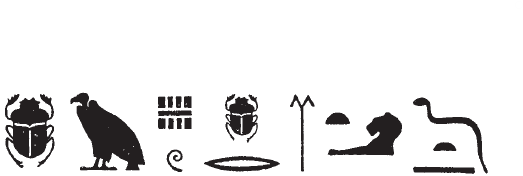 - Tatenen’s name is her reduced to t (scarab) + n (vulture), precisely as recorded by Horapollo, XII; a similar reduced form of Tatenen occurs in Esna 63,3 and Esna 104, 4. In her litany, Neith’s name is spelled with the same two signs, possibly read in reverse, or derived differently (n < nṯr, t < tỉw): Esna III, 216, 6 (25).↩︎
- - el-Sayed 1982, p. 631, translated this all as: “celle qui fut la mère au commencement de l’éternité.” Although the serpent does look like the word “eternity”, this actually refers to the feminine, serpentine demiurge who emerged from Nun alongside Irita at the start of creation; cf. Klotz 2012, pp. 172-174). Neith’s name is often written as the cobra wearing a red crown at Esna, and in her litany, this form is linked specifically to Irita-Tatenen (as in the present text):
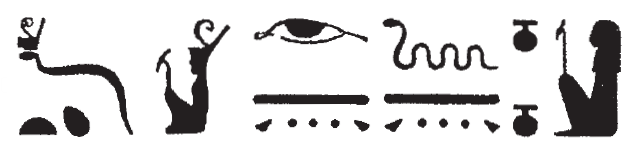 (Esna III, 216, 2, 6).↩︎
 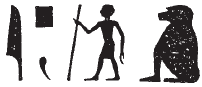 - This appears to be a very full spelling of the copula pronoun ỉpw: first the group ỉp (with otiose f), then w < wr (acrophony; Sauneron 1982, pp. 117-118), followed by the baboon (ỉpw). As I suggested in Klotz 2014b, pp. 55-56, the baboon likely writes pw from its more common use as ỉp, and this example would seem to provide further support. As such, this might be a variant of an epithet of Neith: “the N.t-waters, Nun is her child (n.t nww=s pw nwn)”: Esna III, 317, 1; 252, 27 §5.
However, a similar group occurs in a very different context in Esna III, 385 B, so this might be an epithet instead:
- This appears to be a very full spelling of the copula pronoun ỉpw: first the group ỉp (with otiose f), then w < wr (acrophony; Sauneron 1982, pp. 117-118), followed by the baboon (ỉpw). As I suggested in Klotz 2014b, pp. 55-56, the baboon likely writes pw from its more common use as ỉp, and this example would seem to provide further support. As such, this might be a variant of an epithet of Neith: “the N.t-waters, Nun is her child (n.t nww=s pw nwn)”: Esna III, 317, 1; 252, 27 §5.
However, a similar group occurs in a very different context in Esna III, 385 B, so this might be an epithet instead: 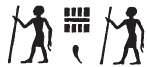 .↩︎
.↩︎The androgynous creator Neith is both the primeval Nun waters, as well as the first water of creation (n.t), homophonous with her name.↩︎
 - Rather than translating this statement literally (“I am established (smn=ỉ)”), this seems to be a mistake for snm, “to eat; feed” (Wb IV, 164, 1-16).↩︎
To understand the terminology in this scene, see Kinnaer 1991. The ỉmỉ.t-pr document is a property deed, and it is usually contained within the protective mks (lit. “it protects”) document holder. The divine property deed encompasses all of creation, especially products from the earth, so Khnum passes this on to Domitian in this scene. Kinnaer 1991, p. 84, remarked the unique appearance of the falcon-headed mks-document holder in this relief; a hieroglyph version of this determines the same word in Esna III, 358, 35.↩︎
 - Presumably this means Nebtu is the great uraeus (i.e. Mut) in Thebes.↩︎
Khnum is identified with Shu (Heliopolis), Shu-Onuris (Thinis), and Nefertem (Memphis). Nebtu-Menhyt with Tefnut (Heliopolis), Tefnut-Mehyt (Thinis), and Sakhmet (Memphis). [^fn-73-4]:
 - Reading uncertain, since this passage mixes traditional 3rd person plural suffix pronouns (=sn) with later forms (=w). Assuming the first two signs (t+n) are an error for the negative arms.↩︎
These are traditional puns on the names of Shu and Tefnut, as in Esna II, 55, 11-12; 31, 58.↩︎
In an earlier offering scene, Khnum-Re Lord of the Field is identified with Shu, and the divine column says Atum created him and his sister (“on the first day of Pakhons (m hrw tpy nt ḥb-ḫnsw)” (Esna II, 8, 14; similarly Esna III, 361, 16). According to the Esna calendar, meanwhile, (Esna II, 77), Pakhons 1 is the birthday for Shu and Tefnut, and their son Heka-Geb; cf. Sauneron 1962, pp. 9, 22, n. a.↩︎
 - Difficult passage, restored after the parallel in Esna 104, 7.↩︎
Most likely the gap contains an epithet of Khnum here (e.g. Lord of Esna, Lord of the Field), but one could reasonably restore the name of Nebtu for the composite Nebtu-Menhyt, since she is actually present in this offering scene.↩︎
Khnum here takes on the epithet of his consort, as if his name were Nebu. This occasionally happens elsewhere at Esna: LGG III, 605b.↩︎
A reference to the union of Khnum-Shu and Nebtu-Tefnut on 1 Khoiak; cf. Esna 81, 4-6. At that time, Nebtu takes the form as “the august one (šps.t)”, just as in this text: Esna III, 346, 24; 351 A.↩︎
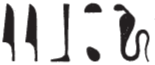 - Emending the second reed leaf to a tall s sign, for this term for a uraeus: Wb I, 20, 19-20.↩︎
The following hymn for giving incense to the uraeus occurs was part of the Daily Statue Ritual and the Ritual of Opening the Mouth, and as such it appears many times in temple scenes from the New Kingdom onwards. In the Graeco-Roman period, it frequently occurs in scenes like the present one, where the king emerges from the palace, being simultaneously protected and purified from incense. For many examples, see Kurth 2004, p. 344, n. 4; Thiers 2015, pp. 314-315, n. ad; Cauville 2015, pp. 45-46. These variants enable the minor restorations throughout the present version.↩︎
Menhyt, the goddess of Esna represented in this scene, is mentioned in most examples of this text going back to the New Kingdom.↩︎
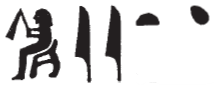 - As Sauneron 1966, pp. 4-5, demonstrated, this spelling of tȝy.t is based on confusion of similar hieratic groups.↩︎
The “bend” or “coil” here refers to the curly part of the red crown.↩︎
 - sḥḏ, “to illumine” < s(r), “ram” + ḥḏ(.t), “white crown.”↩︎
This is the pointy part of the red crown (Meeks, AL I, 1657; see Projet Karnak). Not to be confused with mỉz.wt, “white crown” (Wb II, 44, 15-16).↩︎
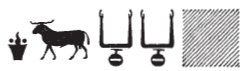 - This phonetic variant sportively alludes to the first god on a standard (a ram, Khnum the Good Protector), and the royal Ka which usually accompanies the king in such scenes.↩︎
For this frequent epithet of Khnum the Good Protector, a manifestation of Shu, see LGG IV, 206a-b; Esna VIII, 553, 9.↩︎
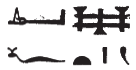 - Unusual spelling of mỉ.t, “path.” The medial diphthong (cf. Coptic ⲙⲟⲉⲓⲧ) seems to have been rendered by the uniliteral f, for which one might compare spellings of Arsinoe in hieroglyphs, where the final diphthong appears as nf: Quaegebeur 1971, pp. 260-261.↩︎
 . Reading uncertain. The initial epithet seems likely, assuming the first sign writes pḏ, “to stretch out (wings)” (Wb I, 568, 2). For the location, compare Esna 58, 1.↩︎
A desert region (mr.t) of Esna is mentioned on the funerary pOIC 25389 (35, 8) belonging to a Latopolite priest: Herbin 1994, p. 273.↩︎
That is, Shu and Tefnut:
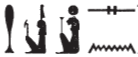 ↩︎
↩︎Restoration suggested by Sauneron. For similar epithets, see Klotz 2014b, pp. 38-39, n. c. ↩︎
Note the spelling of the preposition r (< ỉȝ.t):
 . Not mentioned by Kurth, EP I, p. 323, No. 68.↩︎
That is, sun and moon, as evident from the determinatives:
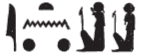 ↩︎
↩︎Unless this is restored differently, this would refer to the southern origin of the Nile in Biggeh Island, near Aswan.↩︎
 - A trio of crocodiles frequently substitutes for the expected triple water signs in this and other words.↩︎
This god was linked to Diospolis Parva in Upper Egypt, and seems to have been a form of Osiris who rejuvenates like the phoenix: LGG II, 379b.↩︎
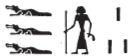 - Just as in the spelling of Nun, this could alternatively write “great waters (mw wr.w).”↩︎
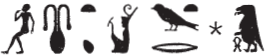 - The spelling of Neith evokes the legend of Methyer and Re, since it consists of: the child (n < nww) + the mother (t < tmȝ.t). The use of the hippo to write “mother” seems unique (Kurth 2007, p. 177, n. 682, cites only this example). Elsewhere, the same sign writes wr.t (< Ta-weret) in the name “Neith the Great (N.t wr.t): Esna IV, 461, S; 463, S.↩︎
 - Remarkable spelling of this epithet using all rams, recalling the Ram Hymn of Esna 103. Most elements occur elsewhere, except perhaps the second ram for tȝ. Presumably this is derived from ṯȝy, “male.”↩︎