Cryptographic Ram Text (103)
Esna 103
- Location: Interior Eastern wall, south corner
- Date: Unknown
- Hieroglyphic Text
- Bibliography: Leitz 2001 (complete); Morenz 2002
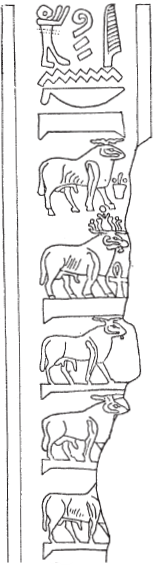
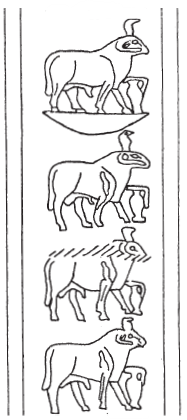
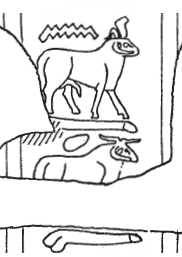
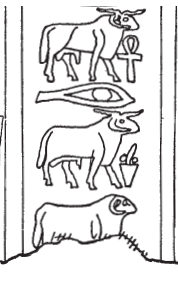
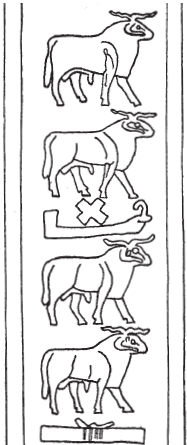
Leitz 2001, p. 254, note 2, provided two exact parallels for this epithet, including the definite article. To those examples, one could also add Esna III, 345, 14, and compare Khnum as the bȝ-ʿȝ (Esna III, 318, 7, 5; 360, 8; Esna IV, 430, 3), bȝ ḥry-nṯr.w (Esna III, 318, 7, 4). The mysterious ram-headed crocodile in Esna 112, 1, is hailed as “Praise be unto you, o Ba great of form (pȝ bȝ ʿȝ ỉrw).” Leitz 2001, pp. 254, 261, did not speculate on the origin of the value ʿȝ. It appears the ram wears the usual crown of Thoth (cf. the crown Thoth wears in Esna 163, 27), and thus represents his typical epithet ʿȝ (cf. Kurth 2007, p. 142, 81); just as the rams wearing Geb’s crown represent his chief attribute. A ram wearing the same crown seems to write ʿȝ in another hymn to Khnum: Esna III, 262, 19, §5.↩︎
It is worth noting that the ram on a standard, a variant of the usual falcon, is a frequent spelling of nṯr, “god” in the temple: Esna 56; Esna III, 202 A,B; 288, 8; 380, 25; 387, 3; 389, 13; 393, 21; 397, A,B; Esna, VII 571 B. A simple ram without attributes or standard can occasionally write this word as well: esna III, 298, A,B; Esna VI, 520, 2; 543, 10.↩︎
Both Leitz and Morenz correctly recognized this ram as nb (n < “red crown”, b < bȝ), but Morenz 2002, pp. 90-91, thought it was an ad hoc value used just in this text. In fact, this spelling occurs quite frequently in various contexts throughout the temple: Esna 53; Esna 146, 2 (damaged); Esna 150, 2; Esna 171 B; Esna 184, 25; Esna III, 368, 29; 393, 23; Esna VI, 541 A; Esna VII, 549.↩︎
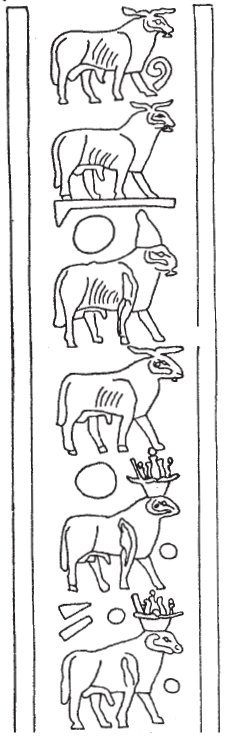
Neither author offered an explanation for the value of the ram wearing the elaborate crown, which also appears in col. 3. However, this is the characteristic crown of Geb, the god of the earth, who frequently writes tȝ at Esna, and already in the New Kingdom: cf. Klotz 2014b, p. 50, Doc. 23, n. b. The next two signs are likely rams without crowns, writing sn.t < s(r) + nt (< nṯr). A similar writing of this toponym with three rams occurs in Esna 76, 15; and two rams for sn.t in Esna II, 17, 5; Esna III, 318, 8 (6). In all of these cases, it is also possible the two rams write sn < snw, “two; siblings.”↩︎
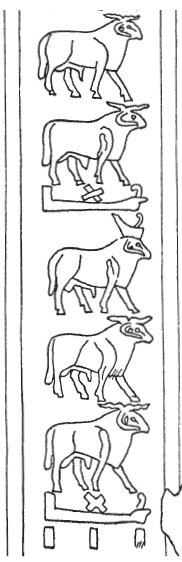
Morenz 2002 read this group the same way, but Leitz 2001, pp. 255-258 objected because this does not explain the uraei, and the usual epithet is “Khnum who made the Khnums.” Instead, Leitz opted for ʿnḫ ỉr ʿnḫ.w, deriving uraeus = ʿ < ỉʿrr.t, ram = n < nṯr, and vessel = ḫ < ẖnmw. However, the first reading is preferable, since the uraeus nowhere else has that value phonetic within the temple. Rather, neither author mentioned that the uraeus often has a different phonetic value when it appears on a ram’s head, in spellings of wbn, deriving the value w < wȝḏ.t. See already Sauneron 1962, p. 155, n. h; Klotz 2014b, 34, n. b; and compare multiple texts that play on alliteration with “Wadjet (Wȝḏy.t) who shines (wpš) on the brow (wp.t) of the king”: Esna 58, 1; Esna 169, 4-6. As a result, the ram + vessel writes “Khnum” (standard group), while the uraeus serves as a final phonetic complement (w).
This exact same combination writes “Khnum” in standard texts from Esna, already in the Ptolemaic Period: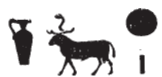 (Esna II, 12, 8). Note that the seated ideogram for Khnum sometimes appears with just a uraeus and no crown at Esna: e.g. Esna 104, 4:
 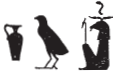 , Esna 104, 5:
  .
Lack of direct parallels is not concerning, because the structure of this hymns has multiple epithets linked “N lord of the N’s”, and certain common epithets at Esna vary between nb and ỉr.↩︎
.
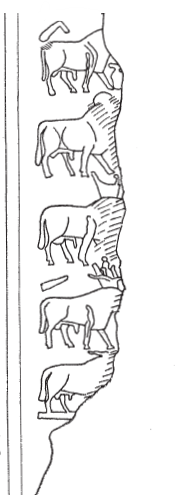
Lack of direct parallels is not concerning, because the structure of this hymns has multiple epithets linked “N lord of the N’s”, and certain common epithets at Esna vary between nb and ỉr.↩︎In Esna 58, 8, a similar group of a ram over disembodied horns appears to write Osiris (w < wp + sr), or possibly bȝ-dmḏ, “the united Ba.” Leitz 2001, p. 255, 6, opted for the latter reading, but it is never used at Esna to describe Khnum. Alternatively, it might write wsr, “mighty”, in the same manner. As another suggestion, I here suppose the ram write q < kȝ, “(male) ram”, and the separate horns write d < dmḏ (regular value at Esna) via acrophony, thus obtaining the verb qdi.↩︎
This reading is uncontroversial, as both values were established in column 1.↩︎
Morenz 2002 read this group the same way, but Leitz 2001, pp. 255-258 objected because this does not explain the uraei, and the usual epithet is “Khnum who made the Khnums.” Instead, Leitz opted for ʿnḫ ỉr ʿnḫ.w, deriving uraeus = ʿ < ỉʿrr.t, ram = n < nṯr, and vessel = ḫ < ẖnmw. However, the first reading is preferable, since the uraeus nowhere else has that value phonetic within the temple. Rather, neither author mentioned that the uraeus often has a different phonetic value when it appears on a ram’s head, in spellings of wbn, deriving the value w < wȝḏ.t. See already Sauneron 1962, p. 155, n. h; Klotz 2014b, 34, n. b; and compare multiple texts that play on alliteration with “Wadjet (Wȝḏy.t) who shines (wpš) on the brow (wp.t) of the king”: Esna 58, 1; Esna 169, 4-6. As a result, the ram + vessel writes “Khnum” (standard group), while the uraeus serves as a final phonetic complement (w).
This exact same combination writes “Khnum” in standard texts from Esna, already in the Ptolemaic Period: (Esna II, 12, 8). Note that the seated ideogram for Khnum sometimes appears with just a uraeus and no crown at Esna: e.g. Esna 104, 4: , Esna 104, 5: .
Lack of direct parallels is not concerning, because the structure of this hymns has multiple epithets linked “N lord of the N’s”, and certain common epithets at Esna vary between nb and ỉr.↩︎Leitz 2001, p. 256, 9, tentatively suggested qn nb qn.w, “strong, lord of the strong”, but noted that epithet is not otherwise attested at Esna. Since the two rams with this determinative could write many things, I would instead opt for qdỉ, “builder”, derived from q < kȝ, “(male) ram” + d < ṯȝy, “male. Leitz 2001, p. 259, 18, suggested that interpretation for an identical group of signs in column 3 (with the support of a parallel), and it seems such a group should have the same reading in both instances. Most importantly, qdỉ nb qdỉ.w is an extremely common epithet of Khnum at Esna, and elsewhere.↩︎
I wholly agree with the interpretation by Leitz 2001, pp. 256-257, 10.↩︎
Partially following the arguments in Leitz 2001, p. 257, 11, but I assume the n belongs to the following group because of the sign layout. There is damage before this section, so it is unclear if the first ram is related to the phrase beginning with the mr-sign.↩︎
Leitz 2001, pp. 257-258, 12, grouped the signs differently, and recognized the common epithet kȝ-sṯỉ, “ejaculating bull.” Yet this assumes the first n is part of the preceding group, assigns a different value another value to the uraeus than in earlier in this column (k), and reading the egg as s (< zȝ or swḥ.t). While that is possible, I prefer to read the uraeus again with its standard value in Esna w (see above), with the ram writing s, as it does in words such as psḏ. This results in another popular epithet of Khnum, wsn, who is often said to “make (egg = ỉr, a standard spelling) sexual pleasure.” In this spelling, the ram apparently writes the first two consonants nḏ < nṯr.↩︎
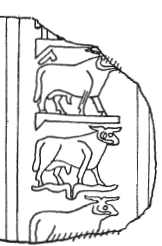
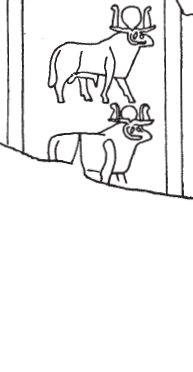
Both Leitz and Morenz read this epithet the same way. Although only two rams are preserved after ỉr, they are both different types, which suggests the final sign would have been yet a different variety. This would be the archaizing practice of indicating a plural through dissimilation, employing three different objects instead of plural strokes: cf. Thuault 2020.↩︎
The ram quite often writes the medial b in wbn at Esna (Klotz 2014b, p. 34, n. b). Unique here is the second ram on a standard, writing n < nṯr.↩︎
Since the first ram wears the white crown (ḥḏ), it is easy to obtain s(r)+ḥḏ, “to illumine,” just as occurs in Esna 74, 28. However, how do we interpret the second ram? In Esna 164 A, a similar group includes the phonetic complement t:
 – so the second ram could perform that function. Nonetheless, there is also an example in Esna 53, where a ram with no crown appears in the word sḥḏ:
  ; similarly in Esna III, 378, 12 and 14. This suggests the ram might derive its value from a toponym sḥty (var. sḥḏ) near Herakleopolis, often written with a ram’s head: Wb IV, 221, 9; Yoyotte 1963, pp. 101-106.↩︎
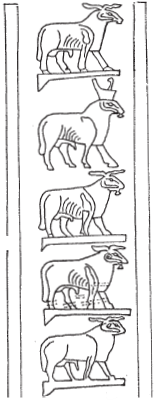
As noted in column 1, the two rams with the Geb crown write tȝ, due to that god’s association with the earth.↩︎
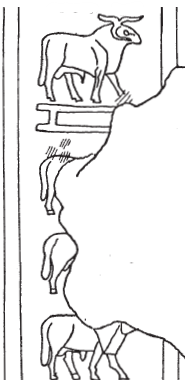
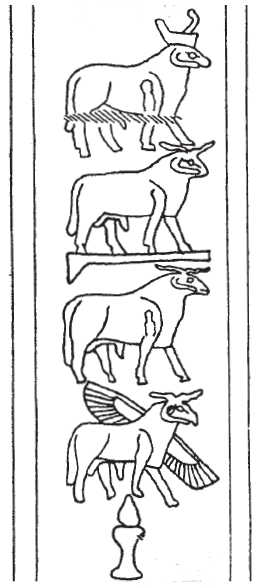
Following Leitz 2001, p. 259 (17) for the first and third signs (n < nṯr, p < pȝy, “to fly”). As Leitz noted, this ram is quite different from the winged ram that writes mḥ, “north” in Esna 163, 26:
 . Most importantly, the wings of this ram are in the same position as the usual pȝ -bird, hence the the substitution here. It is worth noting, however, that a simple ram elsewhere writes p in nḥp (>>add reference>>), probably via phonetic change from b.
Thus far in the inscription, the value ḥas not appeared for the ram, although it does occur in the Cryptographic Litanies. Sauneron 1982, p. 132, suggested it simply derived ḥ < ẖ < ẖnmw, “Khnum.” Alternatively, I suggest this derives from the term hy, “male; husband”, determined with a ram in Esna II, 17, 6; Esna III, 388, 9.↩︎
. Most importantly, the wings of this ram are in the same position as the usual pȝ -bird, hence the the substitution here. It is worth noting, however, that a simple ram elsewhere writes p in nḥp (>>add reference>>), probably via phonetic change from b.
Thus far in the inscription, the value ḥas not appeared for the ram, although it does occur in the Cryptographic Litanies. Sauneron 1982, p. 132, suggested it simply derived ḥ < ẖ < ẖnmw, “Khnum.” Alternatively, I suggest this derives from the term hy, “male; husband”, determined with a ram in Esna II, 17, 6; Esna III, 388, 9.↩︎Leitz 2001, p. 260 (18) tentatively suggested reading qdỉ qmȝ, “who built and created”, based on a singular example of that epithet for Khnum. But as Leitz noted, this introduces the otherwise unattested value of m(ȝ) for the ram. The current proposal relies on the same reading for the first group as qdỉ employed twice in column 2, followed by n(t) + t(ȝ) = nty, “that which is,” using two frequent phonetic values for the ram.↩︎