Intercolumnar Wall A and North-East Door (127-133)
Esna 127
- Location: South-east door, above lintel
- Date: Unknown, probably Domitian
-
Hieroglyphic Text
- Bibliography: Sauneron 1962, pp. 374-375; Sternberg 1985, pp. 100-102 (only cols. 1-8)
NB: This long text is quite damaged. Many of the surviving snippets can be understood by comparing related inscriptions at Esna, especially those concerning the destruction of enemies such as Apophis on Epiphi 19-20 (Esna III, 259-266), the festival of justification on Khoiak 1-6, and descriptions of the sacred necropolis of North Esna.
1[…]
[ʿḫn].n=f [ỉr.ty]=f
r [ḫfty pn]
ẖr ẖkr.w nw ʿḥȝ
[…].n=f […]=sn
[…]2[…]
[…]=f ʿšȝ
ỉr=f ḫrwy.t ʿȝ.t ỉm=sn
hȝ=sn r mw ẖr=fwḥm=f qd=f m [ʿḫ]m
[…] ỉry
[…] wn […]
[…].ỉn ḫr m-ʿ=fsȝḥ=f 3[…]
[…] wḏȝ.ty […]
[…]
Rʿ m [nb]-pḥty
ẖnm=f ḥnʿ=f m sḫ.t
ỉw ỉb=f ȝw.wrdỉ.n=f s(w)
m nb n sḫ.t
ḏ(d).tw n=f
ẖnmw nb-sḫ.tmḥn tfn.t ḥr-tp=f
wpš.n=s m wp.t=f
m-ẖnw 4ww.t tn nfr
ḫpr rn=s n Nb.t-ww1 […]
[he closed] his [eyes]
against [th]is [enemy],
bearing his battle armor.327
[…] he […] their
[…]2 […]
[…] numerous.
He made a great massacre among them,
they went down to the water under it.He repeated his form as a [cr]ocodile,328
[…] likewise,
[…] was […]
[…] fell with him.He reached 3 [….]
[…] the wedjat-eyes […]
[…]
Re as [Lord] of Strength,
he joined with him in the Field,
his heart being happy.He made him
as lord of the Field,
thus he is called
‘Khnum Lord of the Field.’Tefnut coiled up upon his head,
she shone (wpš) on his brow (wp.t),
within 4 this good field (ww),
thus her name became ‘Nebtu’ (Nb.t-ww).ḏd.ỉn Rʿ n mw.t=f
nfr-ỉb(=ỉ) ỉqr zp-snw
ḏr mȝȝ=ỉ zȝ[=ỉ] šw
m nb-pḥty
ỉw sn.t=f m tfn.t
mḥn(.t) m ḥȝ.t=f
ẖnm.t ḥnʿ ȝḫ.t
m spȝ.t tnḏ(d).tw pr-ẖnmw-n-sḫ.t
m rn n ỉȝ.t tnThen Re said to his mother:
‘My heart is glad, and very excellent,
because I see [my] son Shu
as the Lord of Strength,
his sister is as Tefnut,
coiled upon his forehead.
The basin (ẖnm.t) is with the field
in this district.’329So one says Temple of Khnum of the Field
as the name of this mound.5* mȝʿ-ḫrw ỉn ḥm=f
m snw n zp
(hrw) 1/6 n ḥb kȝ-ḥr-kȝ[…] š nṯry
ḥr šms-ỉb=f m ẖnmw
ḥr ỉr(.t) zȝ=f
ḥr mk(.t) ḥʿw=f
ḥr ḫwỉ ḏ.t=f
r ḫrwy.twbn ḥm=f m mȝỉ ʿȝ-pḥty
dỉ=f r tȝ
6m mȝỉ ḥzȝ-ḥr
qn ṯnr nʿš […]
[…]
nwr.n=f ḏw.w m hmhm=fpr=f r=sn
wȝḥ=f ỉmỉ.tw=snỉỉ pw ỉn sn.t=f tfn.t
mnḥ.n=s tp.w nw ḫfty.w=f
7m ḫrpw=s n mȝỉ.t
mr rn=[s n] Mnḥy.t5 Then his majesty was justified
for a second time,
on day 5 (= 1/6) of the Khoiak Festival.330[…] the sacred lake,
following his heart as Khnum,
making his protection,
guarding his flesh,
protecting his body
against massacre.His majesty shone as a lion great of strength,
and he appeared on earth
as a wild-faced lion,
might, brave, raging […]
[…]
the mountains tremble at his war cry.331He came forth against them,
and installed himself in their midst.Then his sister, Tefnut, arrived,
cutting off the heads of his enemies,
in her manifestation of a lioness,
in [her] name [of] Menhyt.[…].n=f gs n […]
m bȝ=tkk
tqr-pḥty
nḫt-ʿ smȝ bdš.w
ỉr ʿḏ.t m ʿȝpp
pḥty pḥty=f m pr-nṯr [….][…] he […] the half of […]
as the raging Ba,
fierce of strength,
mighty of arm, who slays the disaffected,
who makes a slaughter of Apophis:
his strength is strong in Per-netjer […]8pr=f m mȝʿ-ḫrw
m wp.wt[=f] nb.w
wdỉ=sn qn n wḏ[=s]
[…]pȝ wpy ʿȝ
ḫr.tw r=fỉt=f Rʿ m ḥqȝ ȝw.t-ỉb
m ḥb=f nfr
n wḏʿ-mdw
nṯr.w spȝw.t nỉw.wt […]
[…]
9 ʿn.wy ỉry m sw wʿ
r mȝȝ nfrw n ỉtn.wy8 He emerged in justification332
from all [his] trials (wp.t).
They deliver harm to whomever [she] commands333
[…]
the Great wpy-Festival
so they call it.His father Re is ruler of happiness,
in his good festival
of issuing judgements.
The gods of nomes and cities […]
[come to see him…] 334
9 beautiful, likewise, on Day 1
to see the beauty of the two disks.335psḏ.t=f m ỉhȝy
ỉȝ.t=f nṯry twr.tw n kȝ=f
tȝ-r-ḏr=f ẖr ḥry.t=fpr pn nfr
n pḏ-nmt.t ḫnt sḫ.t=f
s.t ḏsr.t pw nt Itm
10ḥw.t-ỉmn wr zp-snw
nỉ rḫ ỉmỉ=s
nỉ ḫnd=s zȝṯ
nn ʿr=s z.t
nỉ sš bwt-nṯr m ḫnt=sḥr.tw zp-snw r bwt=s
swḏȝ tȝ (r)-ḏr=f
r ḫrwy.tẖʿq(?) wnḫ
pȝ nty ʿq r=s
mw n ḥsmn
pȝ nty sḫn ỉm=s
11[pẖ]r nb r=s
twr.tw r zȝṯ
wʿb.tw r s.t
m wʿb nt hrw 8ỉb n z ḥr wȝ.t=s
r swtwt ỉḫt r pr=s
n rʿ-[nb]
fqȝ.w=s […]
[…] tȝ-šmʿ mḥw
nr=s pẖr(.w) m tȝ.wy ḫȝs.wt
nỉ ḥȝt-ỉb m-ḫnt=s [rʿ-nb]His Ennead is in jubilation,
his divine mound is purified for his Ka,
they whole land is in terror of him.This good domain,
of Wide of Steps within his Field:
it is the sacred place of Atum,
the extra secret temple.336
One does not know what is inside,
impurity cannot trespass it,
a woman may not approach it,
the divine abomination may not pass inside.Avoid its abomination,
and keep the entire land safe
from calamity!Shaved(?)337 and clothed must be,
all (men) who enter it;
water and natron (bath is required)338
for all who visit inside;
11 [who ] came around to it,
cleansed from filth,
purified from (contact with) a woman,
for a purification of 8 days.If a man desires to enter her road,
in order to bring gifts to her temple,
[any] day,
she rewards [him…]
[…] Upper and Lower Egypt.
Fear of her encircles all lands,
there is no sadness inside it, [daily].
Esna 128
- Location: South-east door, lintel
- Date: Unknown, probably Domitian
-
Hieroglyphic Text
- Bibliography: None
1 [ṯȝw nfr n ỉȝbt.t ]
[h]n-ḫss rn=f
ntf 2[wṯz] hȝy.ty
r ḥr.t m hȝw 2 […]
r wbg ỉz.ty m ḥḏḏ.wt
4[…] ḥḥ.tw m stw.t […]
[…].n=f m ȝw […]
5[…]=f ḥw.t-nṯr
n nb nḥp
sʿnḫ=f sw
ʿnḫ Ptḥ 6m ḥȝy=f
nḏm [sṯỉ]=f m ḥȝy […]
1 [The good wind of the east:]
[H]en-kheses is his name.339
It is he 2 [who lifts] the two luminaries
up to the sky in the time/area 3 of […]
to illumine Egypt in radiance.
4 […] speeding while […]
[…] he in […]
5 he […] the temple
of the Lord of the Potter’s wheel,
so he might enliven him
Ptah lives 6 from his wind
his [scent] is sweet as the wind […]
Esna 129
- Location: North-East Door, interior, left
- Date: Probably Domitian
-
Hieroglyphic Text
- Bibliography: Sternberg 1985, pp. 103-105; see also Tempeltexte 2.0
- Parallels: Esna III, 196, 3-5. Note that the latter text was inscribed on Column 1, immediately inside this north-east door, and thus very close to the present inscriptions. The same is true of vague parallels between Esna 129 and Esna III, 197.
1ỉr rȝ nṯry
nty [ḥr gs ỉmnty]
n pr-ẖnmw n sḫ.t
s.t-ḥr.t rn[=f]
[…]
ȝḫȝḫ.tw m s[nḏm?] […]
[…ḥw.t-ḥr] nb.t ỉnr.ty
r mȝȝ […]
[…] zȝ=f šw
ḥtp ỉb=f
m-ḫt mȝȝ=f s(w)
As for the divine portal,
which is [on the western side]
[of] Per-Khnum of the Field,340
[its] name is the Upper Place
[…]
flourishing while s[itting?…]
[…Hathor] Lady of Gebelein,341
to see […]
[…] his son Shu.
His heart is satisfied
after he sees him.342
2ḏd.ỉn zȝ n ỉt=f
ỉȝw tw ỉt-ỉtw
tm m ḥʿw=f
ḏd.tw n=f
Itm pȝ wrš n hrw 9
ḫr.tw r=f
ḏr wrš ḥm=f m hrw pn
2 Then the son said to his father:343 Glory to you, father of fathers, he who is complete (tm) in his body!
So one calls him
Atum (ỉtm), the Guard (wrš) of the 9th Day.344
He is called this,
since his majesty guarded (wrš) on this day.
ỉmn=f sw m [ḥr-ỉb ḏw]
ḏd.tw n=s [ḥw.t-ỉmn wr zp-snw]
[…]
[…] sšm Rʿ
qmȝ(.w) ḫnn m-ḫnt=s
3ḥȝp=n sḫr.w=sn
m s.t štȝ.t
ỉmn=sn m ḥr-ỉb ỉȝ.t tn
ḥtpty.w ỉmy.w ỉz=sn
[ỉzy].t šw
Wsỉr mỉt.t
ỉrw=sn ỉmn(.w) m ḫnt=s
stwḫ (r) nfr m […]
He hid himself with[in the mountain]
so one calls it [the great hidden chapel]345
[…]
[…] guiding Re,
those who created chaos therein.346
3 Let us hide their condition
in a remote place,347
and hide them within this mound:
the blessed dead within their tombs,
[the cre]w of Shu,348
Osiris, likewise.
Their physical forms are hidden within it,
being mummified well in […]
[…] ḥr ỉr(.t) ỉz nȝy
r fnḏ=sn rʿ nb
4ḫʿỉ=f r ssw[=f?]
[…] m ḏbȝ.t=sn
m ʿȝ n šfy.t=f
ḫʿ.ỉn Is.t m pr-nṯr
wp=s […]
[… sfsf] ȝw
kȝ[….]
ḫr.tw r bw pn
ʿq nṯr ỉm [….]
[…] m ḫnt=s
ỉw bw mry[=f?]
nỉ sk ḏ.t nḥḥ
[…] making sweet air349
for their noses, daily.
4 He appears at [his?] day
[…] in their coffins,
from the greatness of his prestige.
Then Isis appears in Per-netjer,350
she opens […]
[…to deposit] offerings
[…]
so one calls this place.
The god enters therein […]
[…] inside it,
it is the place [he?] loves,
without fail, for all eternity.
Esna 130
- Location: North-East Door, interior, right
- Date: Probably Domitian
-
Hieroglyphic Text
- Bibliography: None. LGG references in Tempeltexte 2.0
1ỉr ỉȝ.t tn
nty ḥr gs-rsy
n pr-ẖnmw n sḫ.t
s.t-ʿȝ.t rn=s […]
[…].w nty ỉm […]
[nṯr.w] 3 [nṯr.yt] 4
m rn=sn
[Ws]ỉr[-nḫt Inpw ỉmy-P]
ḥr.t zȝ.t-Rʿ ỉwt.t-ww nb.t-ww
ms.w-Rʿ pw
ḫw(.w) mk(.w) m-ḫnt=s
mỉ ỉmḥ.t ẖr 2 ḥtpty.w
wbn ỉt=sn Rʿ
m-ʿqȝ=s
(ḥr) ỉr(.t)-ʿ n ḥts
[…]
[…]=s nty ỉm
1 As for this mound,
which is to the south
of Per-Khnum of the Field.
The Great Place351 is its name […]
[…]s that are there […]
3 [gods] and 4 [goddesses]352
[in] their names:
[Os]iris [the Mighty, Anubis, He who is in Pe],
Horit, Daughter of Re, Iutu(?),353 Nebtu.
They are the children of Re,
guarded and protected within it,
like the cavern354 bearing 2 the blessed dead.
Their father Re rises
across from it
performing the action of mummifying
[…]
[…] which is there.
ḏḥwty pw ḥr shr ỉb=sn
[…]
ẖnm nṯr 8
ḏd.tw n=f
ỉmȝ-ỉb
pȝ-wrš-n-hrw-8
ḫr.tw r=f
3s[..]=f st m ỉhȝy
qbb ỉb=sn ỉm
nỉ ỉr.tw sgb m-ẖnw ỉȝ.t tn
nn ṯȝỉ.tw ṯb.ty m-ḫnt=s
ʿq.tw r=s […]
[…] wʿ.t
nỉ ṯȝ.tw srp.t m-ḫnt=s
m gs-ḥry […]
[…]
ḥr swr nṯr.w ʿȝ.w
ḥtp(.w) m-ḫnt=s
mw nṯry ỉm[…]
He is Thoth, delighting their hearts
[…]
[j]oining the 8 gods.
One says [to] him:
‘Be gracious!’
Thus he is called
the Guard of the 8th Day.355
3 He […] them in jubilation,
their hearts are cooled therein.
One may not shout within this mound,
one may not wear sandals356 within it,
whoever enters it […]
[…of] 1 [day];357
one may not wear ram-skin(?)358 in it,
in the upper part […]
[…]
magnifying the great gods
who rest within it.
The divine water is there […]
4wnn ỉȝ.t tn
ḥr mḥ.t n pr-ẖnmw n sḫ.t
ỉmỉ-wȝḏ=s pw
ỉȝ.t nbw.t-ʿȝy.t rn=s
m rȝ n rȝ
ʿḥʿ tfn.t ḥr=s
m ỉʿrr.t m-ẖnw
wȝḏ n gnš.w
r ḥȝp=s r nṯr.w
ỉỉ.ỉn Rʿ […]
[…]
5[…] wȝḏ.w pn
ḏ(d).ỉn Rʿ
m wȝḏ.w s(t) nfr
ḏd.tw ỉmy-wȝḏ=s
m rn n ỉȝ.t tn
ḏ(d).ỉn [Rʿ] n tf[n.t]
[…] nbw[…]
[…] mỉ [Rʿ] ḏ.t
4 Now this other mound,
to the north of Per-Khnum of the Field:
It is ỉmy-wȝḏ=s,
its name is also ‘Mound of the Great Gold’,359
in oral tradition.
Tefnut stopped upon it,
as a uraeus within
a papyrus thicket of gnš-plants,
to hide herself from the gods.
Then Re came […]
[…]
5 […] this papyrus thicket.
Then Re said:
‘It is nice in the papyrus thicket!’360
Thus one says ỉmy-wȝḏ=s
as the name of this mound.
Then [Re] said to [Te]f[nut]:361
[…] gold […]
[…] like [Re] eternally.
Esna 131
- Location: North-East Door, interior left
- Date: Probably Domitian
-
Hieroglyphic Text
- Bibliography: Goyon 1970; see additional entries in Tempeltexte 2.0
- Parallels: For lines 8-14, see Edfou VI, 155, 8-12; KO I, 181 a (discussed by Goyon 1970, pp. 267-271)
4 […]
5[m rn=k n] bȝw
wȝš r=k
m rn=k n wȝš
6ḏd [bȝ=k]
m rn=k n ḏd-bȝ.w
ḏsr [r=f]
m rn[=k n ḏsr]
7[qfȝ]=k
m rn=k n qfȝ
[…]
4 […]
5 [in your name of] Bau-power!
Be powerful,
in your name of Powerful! 362
[May your Ba en]dure,
in your name of Enduring Bas!
Be sacred
in [your] name [of Sacred]!
7 Be [prestigious],
in your name of Prestigious!
[…]
8ỉ sḫm.t m sf
Wȝḏy.t m pȝ hrw
[ỉỉ.n=ṯ]
[swȝḏ=ṯ* 9 *wḏ]ḥw pn
n ẖnmw-Rʿ nb tȝ-sn.t
mỉ [nn ỉr]=ṯ
n ỉt=ṯ 10Rʿ
m pr=ṯ m P
ḫwỉ=ṯ ẖnmw-Rʿ nb tȝ-sn.t
m wȝḏ [pfy] 11n ʿnḫ
m ʿ=ṯ
m rn=ṯ pfy n Wȝḏy.t
wdỉ=ṯ šsr.w=ṯ
m wnmy.w nb nw 12ḫfty.w=f
ḫpr ḫrwy.t ỉm=sn
mỉ nn sḫm[=t]
13m ḫfty.w nw Rʿ
m zp tpy
m rn=ṯ pfy n 14[sḫm.t]
ỉw ḥtp.w n=t
ẖnmw-Rʿ nb tȝ-sn.t
15ntf Rʿ pr.n=ṯ ỉm=f
wn=f wn=ṯ
ṯz-[pẖr]
8 [O] Sakhmet of yesterday,
Wadjet of today:363
[You have come]
so you might preserve] 9 this [al]tar,
for Khnum-Re Lord of Esna,
like [that which] you [did]
for [your] father 10 Re,
when you came forth from Pe (Buto).
May you protect364 Khnum-Re Lord of Esna
with [this] papyrus 11 of life
in your hand,
in this your name of Wadjet.
May you send your arrows
in all food of 12 his enemies,
so that a disaster results from them.
Like the time when [you] took power
13 [over] the enemies of Re
in the first moment,
in this your name of 14 [Sakhmet].
These offerings are for you!
Khnum-Re Lord of Esna,
15 he is Re, from who you emerged.
As long as he exists, you exist,
and vice-versa.
Esna 132
- Location: North-east door, interior, right
- Date: Domitian
- Hieroglyphic Text
- Bibliography: None
Cartouches of Domitian, beloved of local divinities.
Esna 133
- Location: North-east door, ceiling
- Date: Domitian
-
Hieroglyphic Text
- Bibliography: None
Restored after Esna III, 261, 17, §9; 280, B2.↩︎
 - Other restorations are possible. In a related hymn, Khnum is called “the great crocodile (ḫnt wr), who hides himself in Nun” (Esna III, 265, 26; Sauneron 1962, p. 375).↩︎
This entire speech by Re is resumed almost verbatim in the festival description of Khoiak 2: Esna III, 348, 27-28.↩︎
 - Sauneron 1962, p. 375, n. 1, translated this date as “le premier jour”, but noted its reading was doubtful. If this is fractional notation, then it should be the 5th of Khoiak. It is not impossible that this alternatively reads r sỉn.t, “over Egypt”, a term frequently spelled like this (Wb IV, 153, 7) but one would then expect the nỉw.t-determinative.↩︎
 - The reading nwr seems certain from context. The hmhm-crown often writes the homophonous hmhm, “war cry”: e.g. Esna III, 265, 27; 266, 6↩︎
This section has close parallels with the better-preserved Esna 81, 5-6.↩︎
A reference to the diivinities from neighboring cities arriving during Khoiak 1-6.↩︎
 - Restored after the parallel in Esna 81, 6:
  . From related texts, the two disks are Khnum-Shu and Nebtu-Tefnut: Esna III, 346, 22; Esna 80, 3.↩︎
This is the location near North Esna where Re hid from his enemies: Esna III, 196, 4.↩︎
 - Reading uncertain. Many of the same requirements for entering the divine necropolis of North Esna occur in Esna 197, 18-20. The only difference is this first term, which I tentatively suggest is a slightly confused spelling of Xaq, “to shave”, which is mentioned in Esna 197, 18: (cf. Sauneron 1962, p. 345, n. c). Alternatively, the parallel in the same text mentions wnḫ in the phrase ḥbs n wnḫ, “fine linen clothing”, and this difficult term might instead be a corrupted form of ḥbs.↩︎
Literally “water of natron” or “water and natron”; cf. Sauneron 1962, pp. 340, 346, n. g.↩︎
For this manifestation of the east wind, see LGG IV, 806a-b; Riggs 2006, pp. 317-320 (both with references). The first lines of this text can be restored after the close parallel in the Ptolemaic chapel of Hathor, Deir el-Médinâ 112, 2. Based on those other versions, this figure can be restored as a scarab with a ram head and four wings, as also depicted on the astronomical ceiling: Esna IV, 401 C (East). The southern wind appears in a symmetric scene Esna 105.
↩︎Restored after the similar introduction in Esna 130, 1, and geographic designations of this location in Esna III, 196, 3 (ḥr gs-ḥry ỉmnty n Pr-nṯr); 196, 5 (m gs-ḥry ỉmnty n Pr-ẖnmw).↩︎
Sternberg 1985, p. 103, did not translate this phrase, but the reading is clear. Gebelein was in the orbit of Esna, so perhaps the local Hathor would visit Esna or Esna North, just like other local divinities would do in the month of Khoiak (cf. Sauneron 1962, pp. 47-52).↩︎
Close parallel in Esna III, 196, 4; a shorter mention in the calendar of Esna II, 77 (Payni 9); cf. Sternberg 1985, p. 104, n. c. The mythological allusion is to a period when mankind revolted against Re, and he hid himself within this location. His son Shu (aka Khnum the Good Protector) visits him, kills the enemies, then gives offerings and fresh air to the blessed dead buried in the same spot.↩︎
This entire text is paralleled in Esna III, 196, 4 (cf. Sauneron 1962, p. 325), in a lengthy description of the festival on Payni 9. This was the day when Khnum-Shu massacred the enemies of his father, Re-Atum, hence Atum’s epithet with “Day 9.”↩︎
The same god is mentioned in the hymn to Neith, Esna 163, 27, when she enters the divine necropolis as Isis to give offerings to the deceased. He is also mentioned in the parallel text Esna III, 196, 4, and appears in a food offering scene together with Khnum in Esna VI, 508, 9-11.↩︎
Sternberg 1985, p. 103, did not suggest any restorations. Similar phraseology occurs in the parallel Esna III, 196, 4 (ỉmn.n=f sw m ḥr-ỉb ḏw, ḥw.t-ỉmn wr zp-snw), and the same name for Esna North is linked with Atum in Esna 127, 10.↩︎
According to the fuller account in Esna III, 196, 5, it was the enemies of Re who came and “created chaos (qmȝ=sn ḫnn)” before Shu and his followers massacred them.↩︎
This is apparently the speech of Re to Shu, discussing what to do with the blessed dead who helped suppress the rebellion. The exact same phrase is used to describe Re hiding himself from the rebels in Esna III, 196, 3-4 (ḥȝp.n=f sḫr.w=f m s.t-štȝ.t); cf. Sauneron 1962, p. 328, n. l; and see also Esna 81, 3.↩︎
 - Restored after multiple allusions to the “crew of Re” in the parallel text: Esna III, 196, 3 and 5, and “crew of Shu” (Esna III, 197, 14); cf. Sauneron 1962, p. 326, n. d.↩︎
This is what this form of Khnum-Shu is said to do during the festival of Payni 9: Esna III, 196, 11.↩︎
Possibly an allusion to the festival of Isis on the subsequent day of Payni 10: Esna III, 196, 12. Another procession of Isis occurs in Per-netjer on Thoth 10.↩︎
The “Great Place” is mentioned frequently in the calendars and related festival texts. It is the abaton for the deceased gods, the children of Re, near the temple of Khnum-Re Lord of the Field in North Esna.↩︎
This restoration is suggested by Sauneron 1963a, p. 251, notes a-b. As he mentions, the same list of divinities are listed among the blessed dead who praise Neith north of Esna in the great hymn Esna 163, 27; and they even receive offerings in Esna VII, 613, along with their father Re-Harakhty. Since this is a group of 7 ancestor deities, it is unclear whether they are identical with the 7 Djaisu of Methyer, also said to be buried north of Esna.↩︎
 - The precise reading of this name is tricky; it appears identically in Esna 163, 27, and similarly in Esna VII, 613, 27:
 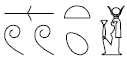 . The first sign elsewhere writes ỉwty (e.g. Esna III, 263, 24) and ʿȝ (e.g. Esna 162, 4; Esna 277, 23 [7]). I prefer to interpret her name as the opposite of her companion, Nebtu: “she without a field”, “lady of the field.” But since this is admittedly a poor divine epithet, “Great One of the Field (ʿȝ.t-ww)” should also be considered.↩︎
This would seem to be the prototypical Egyptian abaton, the cavern in Helopolis, burial place of the children of Re.↩︎
Distinct from “the Guard of Day 9” mentioned in Esna 129, 2.↩︎
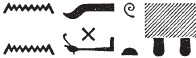 - Such a prohibition is not mentioned elsewhere, but an injunction against wearing leather sandals makes sense, especially with the possible mention of animal skin clothing later. Cf. Sauneron 1962, p. 342, n. f, for an interesting later parallel.↩︎
Restore after Esna III, 197, 16: “all men should be purified from women for a purification of 1 day (m wʿb nt hrw wʿ)”; cf. Sauneron 1962, pp. 340-341, with n. a.↩︎
 - This word is spelled like srp.t, “lotus blossom”, but the determinative would not fit here. Rather, this seems to be a variant of a similar text concerning North Esna, which forbids men to wear “skin of a ram” (šny n sr:
 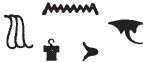 ) when entering the temple: Esna III, 197, 17; cf. Sauneron 1962, p. 342, n. f. Perhaps the final p and t in the present inscription are errors for the animal skin determinative present in the latter text.↩︎
As Sauneron 1963a, p. 241, n. e, pointed out, this same mound is mentioned in Esna 197, 20 (on column 1, immediately inside the door from the present text), and 241, 11.↩︎
 - The syntax is unusual, but this appears to be a way of linking Re’s speech ((ỉ)m wȝḏ s(t)) with the name of the mound (ỉmy-wȝḏ=s).↩︎
Since the following section mentions “gold”, presumably Re’s second speech gave an etymology for the alternate name, “Mound of the Great Gold.”↩︎
The much longer parallel text in Edfou VI, 153-155, contains many such etymologies.↩︎
This text has parallels from a long food purification ritual at Edfu, and a similar doorway at Kom Ombo. It calls on both aspects of the beneficient-dangerous goddess (Wadjyt/Sakhmet): as Wadjet (Wȝḏy.t), she preserves (swȝḏ) the altar (wḏḥw) of Khnum, and protects him with her papyrus-scepter (wȝḏ) of life. As Sakhmet (Sḫm.t), meanwhile, she poisons the food of Khnum’s enemies, taking control (sḫm) of them.↩︎
 - Note the multiple flying creatures in this and the preceding phrase, evoking images of Wadjyt as a winged cobra: e.g. Esna 112, Esna 135.↩︎