Column D (173-179)
Esna 173
- Location: Column D, Upper Bandeau
- Date: Domitian
-
Hieroglyphic Text
- Bibliography: None
[…]
ỉr wnn.t
nṯr nṯry
ḫpr m pȝwty
ẖnmw-Rʿ nb tȝ-sn.t
[…]
who created what exists,
the divine god,
who came about as the Primeval One,
Khnum-Re Lord of Esna.
Esna 174
- Location: Column D, Upper Bandeau
- Date: Domitian
- Hieroglyphic Text
- Bibliography: None
Cartouches of Heka the Child, before Khnum-Re Lord of Esna and Khnum-Re Lord of the Field.
Esna 175
- Location: Column D, middle
- Date: Domitian
-
Hieroglyphic Text
- Bibliography: None
[ʿnḫ nṯr nfr]
ỉwʿ n Rʿ
pẖr-ns.t n nb ḥḥ
nb srḫ
ʿpr-ẖkr.w
wṯz ḫʿ
mỉ zȝ Is.t
nb-tȝ.wy
(twmtyns nty-ḫwỉ)
[Live the good god],
heir of Re,
successor of the Lord of Millions,
lord of the serekh,
fitted with regalia,
who wears the crown
like the son of Isis,
Lord of the Two Lands,
(Domitian Augustus)
Esna 176
- Location: Column D, bottom section
- Date: Domitian
-
Hieroglyphic Text
- Bibliography: Sauneron 1961, p. 241 (line 9); Klotz 2012, p. 277, n. e (lines 9-10). Minor entries in Tempeltexte 2.0
1nṯr-nfr
snw n swȝḏ-bȝ
3-nw n ḥḥ-n-ḥḥ.w
rmn p.t
s[ṯz?] s.t-Rʿ
[…] nḏr ḥḥ.w
šw ḥr twȝ nw.t n ỉt=f
smn.n=f zḫn.wt
ẖr hȝy.t
ḥr wȝḥ s(y) n kȝ=f
mỉ ȝḫ.t wr.t
ẖr dbn.wy
(ḥr) sqȝ sḫm=f
ḫntỉ psḏ.t
dgȝ ḥr.w-nb n bȝw ḥm=f
ḏsr.n=f sštȝ
n ỉt=f šps
1 The good god,
second of swȝḏ-bȝ,
third of Heh of Heh-gods,516
who supports the sky,
who el[evates] the place of Re,
[…] and grasps the Heh-gods.
Shu is lifting up Nut for his father,
having established the pillars
bearing the firmament;
establishing it for his Ka,
like the great Akhet
holding the two orbiters (sun and moon);
raising up his image,
foremost of the Ennead:
all faces see from the power of his majesty.
He made sacred the secret image
of his august father.
2wḫȝ pn
mn(.w) m-bȝḥ=k
ẖnmw tȝ-ṯnn
ỉt-nṯr.w
3bȝw.t n ȝḫ-bỉ.t pw
ʿq=k s(y) m ršw
4ȝw-ỉb=f
n mȝȝ ỉfd.w=f
ỉw mỉt.t=f
nty ỉm=f
5ỉw nty m-ḫnt=f
ỉrw=f nb n mỉt.t=f
2 This papyriform hypostyle hall
is established here before you,
Khnum Tatenen,
father of the gods.
3 It is the bushes of Chemmis,
which you enter in joy,
4 your heart gladdens
to see its four corners.
Its likeness,
which it is,
5 which is within in it,
all of its forms are of its likeness.517
ʿȝ msḫ.wt(=f)
6wr sm.w=f
npry=f ṯḥn.tw
ẖr ḥrr.w nb
7mnḥ nn
nnỉ=k m-ḫnt=f
Mnḥy.t mḥn.t m ḥȝ.t=k
zbt.wt=f ṯḥn.tw n ḥr=k
ỉdḥ pfy
dwn(.w) m-ḥzỉ ḥm=k
8m.k nbỉ.w=f
m sšn r fnḏ=k
ȝw-ỉb=k m ḫnmm=f
ẖnm=f m sṯỉ=f
hr-ỉb=k
n mȝȝ nfrw=f
(Its) fields518 are great,
6 its plants are large,
its grain519 is scintillating,
containing all flowers.
7 This papyrus thicket (mnḥ),520
in which you rest,
Menhyt (Mnḥyt) the uraeus (mḥn) is on your brow,
and its flowers [sp]arkle before you.
This papyrus marsh,
is spread out to meet your majesty.
8 Behold521 its plants!
namely a lotus at your nose,
your heart delights from its fragrance,
you unite with its scent,
and you are happy
from seeing its beauty.
psš.t pw
prḫ.tw m bȝḥ=k
bẖ ỉyḥ.w=f
m pẖr 9m wḥm
ỉnm=f m nbw
gȝbw.t=f m ḫsbḏ n mȝʿ.t
gȝỉ gȝỉ.ty=k
m pr=k r=f
It is a papyrus mat,
rolled open before you!522
Its plants are born
all around 9 and anew.
Its color is gold,
its leaves are true lapis lazuli:
your eyes are astonished523
whenever you come to it!
ỉw=f m zȝ
ỉw=f wȝỉ(.w) r sȝ.t
ỉw=f wʿb.w r ỉḫt nb ḏw
10sfḫ zmȝy.w
n ỉw r sȝḥ=f
snb ḫȝy.t
n swtwt s.t=f
twȝ=sn ỉs
m snỉ-r ḥr.t
mỉ šw ḥr wṯz nw.t
mn.tw ḏd.tw ḏ.t
It is protected,
it is removed from impurity,
it is purified for all evil things;
10 enemies are released
from whomever comes to reach it;
sickness is healed
for whomever makes a pilgrimage to it.
They (the pillars) meanwhile, lift up,
resembling the very sky,
like Shu supporting Nut,
remaining, enduring, eternally.524
Esna 177
- Location: Column D
- Date: Domitian
-
Hieroglyphic Text
- Bibliography: Sauneron 1959, p. 69.
11[ẖnmw]-Rʿ nb tȝ-sn.t
Ptḥ ʿḫỉ p.t
šw twȝ Nw.t
Iwn [m ỉ]w[d p.t] r tȝ
ṯȝw n ʿnḫ (n) nty nb
ʿḫỉ.n=f p.t ḥr sḫn.w=s
smn.n=f tȝ ḥr bȝkȝ.wt=f
sḫpr 525 ỉḫt nb
m qmȝ n ỉb=f
ḥḥ pfy twȝ Nw.t
m ḫprw=f
n grg=f tȝ
m kȝ.t-ḏbʿ.w=f
m ỉrw=f n Nḥp
11 [Khnum]-Re, Lord of Esna,
Ptah who lifted up the sky,
Shu who supports Nut,
pillar of air [between heaven] and earth,
breath of life for all that is.
As he lifted up the sky upon its supports,
he established the earth upon its plots,
he who created all things,
as the product of his mind.
This Heh-god, who supports Nut,
in his visible form
of He founded-the Earth
through the work of his fingers.
in his form of the Potter.
Esna 178
- Location: Column D, Base
- Date: Domitian
-
Hieroglyphic Text
- Bibliography: None
ʿnḫ nṯr nfr
grg spȝ.t tn
n ỉt=f ẖnmw
Live the good god,
who founded this district
for his father, Khnum.
Two standard epithet of Shu, used particularly in his role of supporting the sky. They are both associated with columns from the pronaos in Esna 162, 5-6. For swȝḏ-bȝ, see LGG VI, 210b-c.↩︎
Based on similar passages on other columns (e.g. Esna 155, 3), this gnomic statement seems to claim that every part of the papyriform hypostyle pronaos at Esna is the exact replica of the marshes of Chemmis.↩︎
A similar word is recorded in Wb II 147, 5, but that appears to be a marsh or body of water. The present term seems to be derived from sḫ.t, “field”; see also Esna 155, 4.↩︎
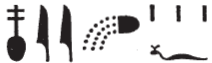 - Notable spelling of npry, for which one may compare the Coptic derivative ⲛⲁⲫⲣⲓ. Similar spellings are attested as early as the First Intermediate Period: cf. Vernus 1987; and see also Esna 155, 4.↩︎
A number of these plant names occur in the similar dedication text (Esna 183), as well as a longer scene of offering papyrus: Esna III, 292, 23-24; Sauneron 1962, p. 140. For the mnḥ-plant, see Sauneron 1966, pp. 1-2.↩︎
 - Unique sign, which I assume is a variant of the bed to write mk, “to protect.”↩︎
For psš.t, see Wb I, 555, 1. The verb matched to this term via alliteration (prḫ) can also mean “to blossom”, so one might understand this phrase differently: “it is a psš-plant blossoming before you.”↩︎
For this passage, and the reading of the terms (gȝ, “to stare in astonishment,” not ptr, “to behold”), see Sauneron 1961, p. 241.↩︎
This last section, describing the supportive function the papyriform columns perform, also occurs in the similar text Esna 183, 9-10.↩︎
Note the unique spelling of sḫpr:
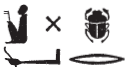 ↩︎
↩︎