Intercolumnar Wall D (68-70)

Esna 68
- Location: Facade, intercolumnar wall D
- Date: Vespasian
-
Hieroglyphic Text
- Bibliography: None
Cartouches of Vespasian.
Esna 69
- Location: Facade, intercolumnar wall D, bandeau
- Date: Unknown, probably Claudius
-
Hieroglyphic Text
- Bibliography: Elgawady 2016, p. 195.
jj.tw m ḥtp
[ẖnm=k? pr]-wr
ḫʿ=k m nfrw=k
m r’ n pr=k
mj Rʿ psḏ m ȝḫ.t
Wp-Wȝ.wt m-ḥȝ.t=k
psḏ.t ḥnʿ=k
bȝ.w P Nḫn jmyt-ḫ.t=k
ḥr ḥr sqȝ sšm=k
jw=k ḫʿ.tw [ḥr] s.t-ḥr ḏ.t
Welcome in peace!127
[May you enter the Per]-wer, 128
appearing in your perfection
at the gate of your temple,
like Re shining in the Akhet.
Wepwawet is before you,
the Ennead is with you,
the Bas of Pe and Nekhen follow you,
and Horus lifts up your image,
you appear [upon] the throne of Horus, eternally
Esna 70
- Location: Facade, intercolumnar wall D
- Date: Tiberius (not Claudius, as Sauneron claimed; cf. Grenier 1988, pp. 57-59)
-
Hieroglyphic Text
- Bibliography: Elgawady 2016, pp. 196-197.
The King
1nsw.t-bỉty
nb-tȝ.wy
(ṯybrys)
2zȝ-Rʿ nb-ḫʿ.w
(kysrs nty-ḫwỉ)
1 The King of Upper and Lower Egypt,
Lord of the Two Lands,
(Tiberius),
2 Son of Re, Lord of Appearances,
(Caesar Augustus)
Nekhbet
3ḏd-mdw ỉn Nḫb.t
ḥḏ.t Nḫn
dmḏ=ỉ ḥnʿ sn.t=ỉ
ḥr ḫfʿ ʿ.wy=k
4r mȝȝ=k ỉt=k
ẖnmw nb nṯr.w rmṯ
5bs r ḥw.t-nṯr n ỉt=k
nb Iwny.t
ỉr=f ʿnḫ r fnḏ=k
ỉmy n=ỉ ʿ.wy=k
snb=ỉ ḥʿw=k
mȝȝ=k nṯr
ỉỉ.n=k ḫr=f
3 Words spoken by Nekhbet,
the luminous one of Nekhen:
I join together with my sister,
grasping your hands,
4 so you might see your father,
Khnum, Lord of gods and people.
5 Approach the temple of your father,
the lord of Iunyt,
so he might create life for your nose.
Give to me your hands,
I shall make your body healthy,
so you might see the god,
before whom you have come.
Wadjet
6ḏd-mdw ỉn Wȝḏy.t
nb.t ḏp P
ḫʿỉ=k ḥnʿ=n
šzp.tw=k
7nb nḥp m [nḏm/ȝw.t]-ỉb
sʿšȝ=f ḏȝm.w=k
8spr r ḥw.t-ẖnmw
n ỉt-ỉt.w […]
sšm=ỉ k(w) (ḥr) wȝ.t
sqd=k ỉm=s
snṯr(=ỉ) k(w)
r pʿ.t rḫy.t
6 Words spoken by Wadjet,
Lady of Dep and Pe:
May you appear together with us,
so the Lord of the Potter’s wheel
7 might receive you in joy,
and magnify your population.
8 Arrive to the Temple of Khnum,
of the father of fathers […]
I guide you (upon) the path 129
through which you travel,
I make you more sacred
than nobles or commoners.130
Before both goddesses
9mỉ ḥnʿ=n m bȝḥ ỉt=k ẖnmw
šzp=f tw=k m nfr
ỉw ỉb=f hr.w
dỉ=f n=k
nḥḥ m nsw.t tȝ.wy
ḏ.t m ḥqȝ ȝw.t-ỉb
9 Come with us before your father, Khnum,
so he might receive you well,
his heart being glad.
May he give you
cyclical eternity as king of the two lands,
linear eternity as ruler of happiness.
Heka
10ḥkȝ pȝ ẖrd
ʿȝ wr tpy n ẖnmw
10 Heka the Child,
the very great first-born of Khnum.
Khnum-Re Lord of Esna
11ḏd-mdw ỉn ẖnmw-Rʿ nb tȝ-sn.t
sḫm šps
ḥry nṯr.w nb
Km-ȝ.t=f 12qmȝ wnn.t
kȝ ỉr kȝ.w
ḫpr ḫnt
nfr-ḥr
nb šwty wr
bȝ pw ỉr nṯr.w
13wbn tp=f
ỉw tȝ ȝbḫ(.w) m zmȝwy
ỉr.t=f ḥr sḥḏ tȝ.wy
14qdỉ rmṯ ms nṯr.w
ʿ.wt nb mỉt.t
wnn.t nb ḫpr=sn m ʿ.wy=f
15ẖnm.n=f tȝ (r)-ḏr(=f)
ḥr nḥp=f
ʿnḫ ʿnḫ.tw ỉm=f
ṯȝw n ʿnḫ tp-rȝ=f
16Imn wr
ḫpr ẖr-ḥȝ.t
ỉr p.t tȝ dwȝ.t
mw ḏw.w
nṯr ʿȝ ḥr-ỉb Iwny.t
17dỉ=ỉ n=k rsy.t r-ʿ ṯȝw
mḥy.t r-ʿ mw
tȝ.wy nb (ḥr) snỉ-tȝ n bȝw=k
11 Words spoken by Khnum-Re, Lord of Esna,
the august power,
chief of all the gods,
Kematef, 12 who created what exists,
Ka serpent who made the Kas,
who came about before.
Beautiful of face,
lord of the double plumes,
he is the Ba who made the gods.
13 His head 131 arose
while the earth was mixed in darkness,
his eyes illumined the two lands.132
14 He who builds people and fashions gods,
all animals likewise,
all things came about through his hands,
15 he united the entire land
upon his potter’s wheel.
Life, through whom one lives,
whose utterance is the breath of life,
16 Amun the great,
who came about in the beginning,
who made heaven, earth, Duat,
waters and mountains:133
(in short) Great God within Iunyt.
17 I give you the south as far as the wind,
the north as far as the water,
all lands kiss the earth for your power.
This text is properly speaking a caption above [Esna II, 70], where Nekhbet and Wadjet introduce the king to Khnum and Heka the child.↩︎
Wadjet uses the archaizing form of the second person masculine singular dependent pronoun k(w), instead of tw/ṯw. Cf. Vernus 2016, pp. 208-213.↩︎
 - A notable heraldic spelling of pʿ.t rḫy.t, confirmed by a fuller writing in Esna 191,11:
 ; same in Esna VII, 582, 16.
The first sign is relatively common, but the latter has not been registered before. Typically, a person holding a small bird or goose writes zȝw, “Sais” (Kurth 2007, p. 132, 25e). The current phonetic value is apparently derived from two geese in the word rḫ.ty, “washers” (Wb II, 448, 9-11); as also suggested by Elgawady 2016, p. 196, n. 1370. A similar goose appears in this word in Esna IV, 416, 2:
; same in Esna VII, 582, 16.
The first sign is relatively common, but the latter has not been registered before. Typically, a person holding a small bird or goose writes zȝw, “Sais” (Kurth 2007, p. 132, 25e). The current phonetic value is apparently derived from two geese in the word rḫ.ty, “washers” (Wb II, 448, 9-11); as also suggested by Elgawady 2016, p. 196, n. 1370. A similar goose appears in this word in Esna IV, 416, 2:  ↩︎
↩︎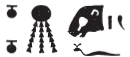 - Elsewhere at Esna, a similar animal head typically writes ȝ.t, “moment.” This is most likely a hippopotamus head, which elsewhere writes Dp, “Buto”, via substitution with the human head (Klotz 2015, p. 104, n. 136).↩︎
The same cosmic event, the initial creation of light by Khnum, is described in greater detail in Esna II 17, 12-15, with a direct parallel to this text: “while the earth was mixed in darkness (ỉw tȝ ȝbḫ(.w) m zmȝwy) (…) he opened his eyes, and light came into being immediately (ptḥ.n=f ỉr.ty=f ḫpr wyn ḥr-ʿ); cf. Fernández Pichel 2018, pp. 34-39; Esna VI, 541, South. The text previously mentioned Kematef, the first serpent god who remains in Nun; his successor, Irita, is typically the one who rises from Nun, head first, to create light and solidify the earth: Klotz 2012, pp. 122-125. Just like Amun in Thebes, Khnum at Esna embodied both”generations” of the creator.↩︎
Typical epithets of Amun in the Graeco-Roman period, who is usually “lord” of this list of celestial regions: Klotz 2012, p. 60, with n. 104. Applied to Amun elewhere at Esna II, 25, 8-9; Esna VI, 487, 10-11; 518, 8-9.↩︎