Intercolumnar Wall F and South-East Door (57-64)
Esna 57
- Location: Facade, intercolumnar F, corniche
- Date: Domitian
- Hieroglyphic Text
- Bibliography: None
Cartouches of Domitian.
Esna 58
- Location: South-east door, Lintel
- Date: Domitian
-
Hieroglyphic Text
- Bibliography: See entries in Tempeltexte 2.0
- Parallels: The first section is paralleled exactly in Esna VI, 474.
1ỉȝ.t ṯȝ.wy
s.t-ʿn.t n ỉrỉ-tȝ
r’-ḥn.t
n tmȝ.t ḥnʿ ḏt
rhn=sn ỉs m-ḫnt=s
ẖnm=f sy m ršw
m rn=f n ẖnmw
mn=s ḥȝ=f
m rn=s n Mnḥy.t
wpš.n=s m wp.t=f
m rn=s n Nb.t-ww
1 The Mound of the Chicks,67
it is the stronghold 68 of Irita,
the Mouth of the Canal (r’-ḥn.t)69
of the mother together with the ḏ-serpent,70
they rested (rhn)71 themselves within it.
He unites (ẖnm) with her in delight,
in his name of Khnum (ẖnmw).
She stays (mn) behind (ḥȝ) him,
in her name of Menhyt (Mnḥy.t).
She shone (wpš) upon his brow (wp.t),
in her name of Nebtu (Nb.t-ww).72
2nṯr.w [wr].w pȝwty tpy
ỉỉ=sn ḫr=f
ms.w tȝ-ṯnn
m 7 ḏȝỉs.w wr.w
nw Mḥ.t-wr.t
ỉmỉ-ỉb=sn ḥnʿ=sn
r sšm sḫr.w Nwn
r nw=f
r ṯz tȝ m pr.t=sn
3 kȝ.n=f tȝ
ḫr ẖnmw.w wr.w
ms.n=f nṯr
ỉr kȝ.t nn ȝb
2 The great gods of the first primeval time,
they come before him,
(namely) the children of Tatenen,
being the Seven Djaisu
of Mehet-weret.73
They conferred74 with one another
to regulate the condition of Nun
at his time,
and to bind the earth with their seed.
3 He planned the earth,
before the Great Khnums,75
he birthed the god,
(to) do work, without cease.
ỉw ȝy spr Rʿ ỉm
ḥnʿ ms.wy=f
drp-rȝ=sn ỉr=f
ḫr ỉt.w=sn
ȝb ỉb=sn
ḥr s.t
ỉt mw.t=sn
ḏr bȝḥ
Now Re arrived there,
together with his two children,
they made fed their mouths
before their parents,76
whom their hearts desired,
upon the throne
of their father and mother,
since forever.
4ỉr.n=f mr=f nb
ỉr.n ms.w=f mỉt.t
ḥr-sȝ=f
ỉw ȝy ḏr ỉw ḥm=s
nšn.tw
snỉ=s ỉrw=s
mfk kȝ=s
wrh n=s šw
pẖr-ỉb=s m-ḫt=f
msḫȝ[-ỉb]=sn m zp
4 He did all he desired,
his children did the same
after him.
When her Majesty arrived,
being enraged,
she changed her visible form,
her Ka became turquoise,
Shu danced for her,77
her heart went out after him,
their [hearts] delighted together.
5wtṯ=sn zȝ=sn
m ḥw nb kȝ.w
ḫpr rn=f n ḥkȝ
Gbb pw
m ḫy nfr zȝ nỉw.t=f
5 They engendered their son
as Hu (ḥw), lord of food (kȝ),
his name became Heka (ḥkȝ),
he is Geb
as a good child, who protects his city.
Wsỉr ḥtp(.w) ỉm
sn.ty [ḥn]ʿ=f
zȝ=f ḥr (ḥr) ẖnm ỉm=f
6šzp.n=f nswy.t
n ỉt.w=f
ḏḥwty r-gs=sn
ỉsṯ (ḥr) sḥtp ḥm
psḏ.t
ḥr ỉr ḏd=sn nb.w
ẖnm ỉt ḥnʿ mw.t
zȝ ḥnʿ zȝ.t
ḏd.tw ḥw.t-ỉt
ḥw.t-mw.t
ḥw.t-ṯȝ.wy
m rn n spȝ.t tn
Osiris78 rests there,
his sisters are [wi]th him,
his son, Horus, reunites with him,
6 having received kingship
from his parents.
Thoth is at their side,
meanwhile, 79 appeasing the majesties
of the Ennead 80
by doing all that they say.81
The father joins with the mother,
the son with the daughter,
one says Temple of the Father,
Temple of the Mother,
or Temple of the Chicks,
as the name of this district.
7pȝwty.w m-ḫnt=s
psḏ.t m-[ḫnt]=s
[šȝʿ m] tȝ-ṯnn
nfry.t r ḥr[-zȝ-Is.t]
[…]
ỉnb-ḥḏ=sn pw m tȝ-šmʿ
nn ḥr r=sn […] ḏ.t=sn
qd=sn ḏd(.w) m ḫnt=s
nt-ʿ=sn [mn(.w) nn ȝb]
rʿ-nb
7 The primeval gods are in it,
the Ennead is [in] it,
[from] Tatenen
down to Har[siese] 82
[…]
It is their Memphis in Upper Egypt.83
They do not stray [from] their bodies,
their statues endure within it,
their rites [endure without fail],
every day.
Esna 59
- Location: South-east door, Left
- Date: Domitian
-
Hieroglyphic Text
- Bibliography: Sauneron 1963b, p. 50 (ending only)
1ʿnḫ nṯr nfr
nbỉ ẖnmw
m ȝ.t n.t snfr-ỉb
ỉwʿw n nḥp
(tmtỉʿns nty-ḫwỉ)
ḏd=f n ỉt=f šps
ẖnmw-Rʿ nb tȝ-sn.t
sḫm šps
nfr ỉrw
ʿȝ sḫr.w
wṯt nṯr.w rmṯ
ṯȝw n ʿnḫ
n ʿš.tw n kȝ=f
ỉnk ḥʿw=f-ʿnḫ
pr ḥr nḥp=f
ḫpr sḫr.w=ỉ
m wḏ kȝ=k
mỉ m ḥtp
ẖnm=k ḥw.t=nṯr=k
[…]
1 Live the good god,
fashioned by Khnum,
in the moment of pleasing the heart,
heir of the Potter,
(Domitian84 Augustus)
He says to his august father,
Khnum-Re, Lord of Esna,
august power,
beautiful of appearance,
great of plans,
who begets gods and men,
breath of life
for whomever calls85 to his Ka:
I am he whose body lives,
who emerged upon your potter’s wheel,
my plans came about
through the command of your Ka.
Come in peace!
Enter your temple
[…]
2pʿy.t ỉsk
pʿpʿ=k pȝwty.w ỉm=s
šȝʿ.n=k ʿnḫ n tȝ m-ẖnw=f
sȝ-n-ʿnḫ
sḫn=k srḫ=k ḥr=f
sn.t=k ỉs ḥnʿ=k
nṯr.w ỉm=f m ršw
mȝȝ=k smn.w ỉr.n=ỉ
n pr=k
šsp=k sw m-ʿ=ỉ
ỉw ḥm-nṯr=k bȝ.w
nỉ ỉw šw n pr=k
ỉw=ỉ […] ḥr […]
[…] rʿ-nb
“(It is), meanwhile, the mound
from which you birthed the primeval ones,
you began life for the earth within it.
“(It is) the stable of life,86
on which you joined your serekh,
your sister, moreover,87 is with you,
the gods within it are in joy.
“May you see the statues I made
for your temple,
and receive it all from my hand.
“Your priest is present 88,
no lack shall come to your temple.
“I am […]
[…] every day.
Esna 60
- Location: South Anta, Soubassement
- Date: Uncertain, Vespasian
-
Hieroglyphic Text
- Bibliography: Sternberg 1985, pp. 68-78; see also Tempeltexte 2.0
1ỉr ỉȝ.t tn
Iwny.t rn=s
bw pw ỉw Rʿ r=s
ḏd=f n šw tfn.t
Iwnw=tn pw ḏr-bȝḥ
ḏd.tw Iwny.t m rn
[…]
ḥm.w=sn
ḫnt pw ỉr m ỉb=s
spr ḥm=s r wȝs.t šmʿ
2ḏd=sn n=s
ḫntỉ r=t r Iwny.t
rsy Nỉw.t
nỉw.t tn ns-sw ẖnmw Mnḥy.t
ḏd.tw (tȝ)-sn.t
m rn n spȝ.t tn
[ỉw] ỉb=s [nḏm] r=s
wn=s [ḥr] ḏd
ỉw=ỉ r ḫpr ỉm
ḫpr [rn] n pȝ mỉ(t)
r pȝy m-mȝʿ
r-mn hrw pn
1 As for this mound,
Iunyt is its name.
It is the place to which Re came,
and he said to Shu and Tefnut:
This is your Heliopolis (Iunu) of long ago!
Thus it is called Iunyt.
[…]
their majesties.
It was a desire to go south (ḫnt)89 in her heart.
Her majesty reached Upper Egyptian Thebes.90
2 They said to her (there):
‘Go further south (ḫnt) to Iunyt,
south of the City (Thebes).91
That city belongs to Khnum and Menhyt.’
Thus one says Esna
as the name of this district.
Her heart [was glad] about it,
and she said:
‘I will be there (ỉm ).’
Thus the [name] of the [ro]ad
became This one Truly (m-mȝʿ.t)
until today.
spr=s r ỉȝ.t tn
3ḫpr N.t ỉm
ḥr zȝ ḥm=sn
m nỉw.t tn
tȝ štȝ.t rsy.t pw
n pȝ ḫnty tȝ
ḫpr ḫnt-tȝ
m rn n ỉȝ.t tn
She arrived at this mound,
and thus Neith came about
protecting their majesties
in this city.
She is the southern vulture,
of the limit (ḫnt) of the earth (tȝ).92
Thus came about ‘Khent-ta’ (ḫnt-tȝ)
as the name of this mound.
ʿm nṯr.t ỉr=s ỉn tfn.t
n-mrw.t ỉr.t mk=s
m-ʿ ky.w sbỉ(.w)
wʿr=s r sḫ.t-Rʿ
mḥy nỉw.t ṯn
4ḥn ỉr=f ỉn ḏḥwty
r bw wn=s ỉm
r mḥ.t wḏȝ.t
m ẖ.t=s
mḥ.t(w) m ḥkȝ=f
Tefnut swalled the diminished, divine eye,93
from a desire to carry out its protection
from the rebel enemies.
She fled to the Field of Re,
north of this city.
4 Thoth meanwhile hurried
to the place where she was
in order to replenish the wedjat-eye
in her belly:
so it was filled through his magic (ḥkȝ).
wbn ḏfḏ n ỉr.t-Rʿ
ỉmỉ.tw ỉḥ.ty=s
m twt n ḫprỉ
m ḥr n syf šps
ḏ(d).tw n=f ḥkȝ
wr-ḥkȝw kȝ n Rʿ
qbb ỉb=s ẖr=s
5ỉṯ s(w) N.t
m ḥb Rnn.t
ẖnm sw šw m ʿ.wy=f
The iris of the Eye of Re arose
from between her thighs,
in the form of a scarab beetle,
with the face of an august child.
One called him Heka (ḥkȝ),
Greatest of Magic (wr-ḥkȝ), Ka (kȝ) of Re.
Her heart was soothed with this.
5 Neith takes him
during the festival of Renenutet (Pharmouthi),94
so Shu might embrace him with his arms.
ḏd.ỉn Rʿ
ntṯ tmȝ.t
ḫpr m zp-tpy
mnḥ=t ḥʿw=f
mḥn=t ḥr-tp=f
ḏ(d).tw n=s Mnḥy.t
sḫm mwt.=f
m sbỉ ḥr=f
m rn=s n sḫm.t
ḏ(d).tw n=f
zȝ sḫm.t
ỉr.tw n=f msw-nṯr
m nỉw.t tn
ḏd Rʿ n tfn.t
ntṯ zȝ.t=ỉ wsr.t
ỉr=ṯ nb.t ww
ḏd.tw n=s nb.t-ww
šm=s r sḫ.t
m hrw ẖn.t
ỉwty [ȝb] rʿ-nb
Then Re said:
‘You are the mother,
who came about in the beginning:
may you rejuvenate (mnḥ) his body,
and encircle (mḥn) upon his head.’
Thus she is called ‘Menhyt (Mnḥy.t).’
His mother took control (sḫm)
over anybody who rebelled against him,
in her name of ‘Sakhmet’ (Sḫm.t).
Thus he is called
‘Son of Sakhmet.’
One performs the Divine Birth ritual95 for him
in this city.
Re said to Tefnut:
‘You are my mighty daughter.
May you serve as Lady of the Field (nb.t ww).’
Thus she is called ‘Nebtu (Nb.t-ww).’
She goes96 to the field,
on the day of the bark procession,
without [fail], every day.
Esna 61
- Location: South-east door, left side of lintel
- Date: Unknown, Domitian
-
Hieroglyphic Text
- Bibliography: Leitz, Löffler 2019, pp. 86-88.
Formula
1mn n=k nḥp pfy
mry ỉb=k
ỉn kȝ.t=k grg tȝ pn
1 Take this potter’s wheel,
which your heart loves:
It is your work which settles this earth.
The King
2nsw.t-bỉty
(ỉwtkrtr ksrs)
3zȝ-Rʿ
(twm[…])
4zȝ-mr=f
n nb-nḥp
2 King of Upper and Lower Egypt,
(Autokrator Caesar)
3 Son of Re,
(Dom[itian Augustus]),
4 His-beloved-son priest 97
of the Lord of the potter’s wheel.
Khnum-Re Lord of Esna
5ḏd-mdw ỉn ẖnmw-Rʿ nb tȝ-sn.t
6ḥry-nḥp
qdỉ r-mr=f
grg tȝ 7m kȝ.t=f
rʿ-nb
5 Words spoken by Khnum-Re Lord of Esna,
6 chief of the potter’s wheel,
who builds as he desires,
who settles the earth 7 through his work,
daily.
Menhyt
8ḏd-mdw ỉn Mnḥy.t wr.t
nb.t ḫnt-tȝ
9msḫn.t nfr.t
ỉr(.t) mr=s 10 […]
8 Words spoken by Menhyt the great,
Lady of Khent-ta,
9 good birth-brick,
who does what she desires 10 […]
Heka
11ḏd-mdw ỉn ḥkȝ pȝ-ẖrd
ʿȝ wr tpy n ẖnmw
12sḏ ỉqr nn mỉt.t=f
11 Words spoken by Heka the Child,
very great first-born [of] Khnum,
12 excellent youth without his equal.
Esna 62
- Location: South-east door, right side of lintel
- Date: Unknown, Domitian
-
Hieroglyphic Text
- Bibliography: el-Sayed 1982, p. 626, Doc. 1010; Gamelin 2019, p. 27 (partial translation).
The King
2nsw.t-bỉty
(ỉwtkrtr ksrs)
3zȝ-Rʿ
(twmtyns […])
4sḥtp mw.t=f m sṯỉ nḏm
2 King of Upper and Lower Egypt,
(Autokrator Caesar)
3 Son of Re,
(Domitian [Augustus]),
4 who appeases his mother with sweet scent.
Neith
5ḏd-mdw ỉn N.t wr.t
mw.t-nṯr nb.t tȝ-6sn.t
tmȝ.t m šȝʿ
sḫpr nty
7[…]
zȝ=s šww (ḥr) sḥḏ tȝ.wy
5 Words spoken by Neith the great,
Mother of God, Lady of 6 Esna,
mother in the beginning,
who created what is,
7 […]
her son the sun illumines the two lands.
Esna 63
- Location: South-east door, left side
- Date: Unknown, probably Domitian
-
Hieroglyphic Text
- Bibliography: el-Sayed 1982, p. 636 Doc. 1027 (partial translation)
1rȝ rsy sn.t pw
kȝ.tw rn=f r [rs]-n.t
m ḥw.t-N.t m tȝ-šmʿ
mw.t-nṯr štȝ.t m-ḫnt=f
s.t-ỉb=f pw
ȝḫ sy r p.t
wṯz=s ḫʿ ỉm=f
mỉ wn=s ḫnt Nw.t
ḫʿ=s r [Pr-nṯr ?? …]=sn
šmr.t m […]
[…] 21/2 1/30 n 2.nw n pr.t
drp pȝwty.w ỉm=f
sṯȝm nṯr.w m-ḫnt=f
wrḥ psḏ.t m-ẖnw=f
ḥw.t-nṯr=s ḥnʿ.t m ỉḫt nb nfr
nỉ ḏd ḥȝ-n=ỉ m pr=s rʿ-nb
ḏr ḏd.tw n […]
[…]
nṯrw nṯry.t nb n tȝ-šmʿ tȝ-mḥw
ḥr s[…]
1 This is the southern door of Esna,
it is called the [Rs]-n.t (Southern Neith chapel)98
in the temple of Neith in Upper Egypt.
The Mother of God, the mysterious, is in it,
it is her favorite place,
it is more glorious than heaven.
She goes out in procession from it
as if she were within heaven,
she goes forth to [Per-netjer?…]99
a bow in [her hand…]
[…] 2 the 16th of the second month of Peret (Meshir):100
the primeval gods are fed therein,
the gods are clothed therein,
the Ennead is anointed within it.
Her temple is provided with all good things:
Nobody says ‘O would that I had…’101 in it, daily.
Since one said to […]
[…]
gods and goddess of Upper and Lower Egypt
are […]
3ḥw.t-ỉt pw
n ỉt m ḥȝ.t
ḥw.t-mw.t mỉt.t
n tmȝ.t m šȝʿ
nṯr wʿ pw ḫpr nṯr snw
tȝ-ṯnn N.t
ḫpr ḫpr.w (?)
ḥw.t-ẖnmw n zȝ.w-n=sn
stp.w-zȝ ḥȝ nṯr ʿȝ
s.t-nbỉ
n nbỉ nṯr.w
qdỉ rmṯ ʿ.wt nb.w
m rn=f n Ptḥ
qmȝ swḥ.t
pr m [Nwn…]
[…]
4snṯ n ẖnmw
r šms-ỉb=f m-ḫnt=f
nbỉ.n=f ḥr.w nb ḥr nḥp=f
qdỉ.w ms.tw m-wn
r rmn m bȝḥ=f
ḥr nḥ.t ʿnḫ=sn m-ʿ=f
nṯr.w nṯry.w m ỉȝw n ḥr=f
r grg nỉw.wt m kȝ.t=f
dỉ zȝ n dwȝ sw
zȝ.t n dbḥ sw
ḏd […]
3 It is the Temple of the Father
for the Father in the beginning,
likewise the Temple of the Mother
for the Mother at the start of time,102
that means the sole god, who turned into two:103
Tatenen and Neith,
whose existence came about(?).104
The Temple of Khnum of the guardian deities105,
they perform protection around the great god,
the Place of Fashioning
of He who Fashioned the gods,
and who built people and all animals
in his name of Ptah,
who created the egg
(and) who came forth from [Nun…]106
[…]
4 being founded by Khnum,
in order to follow his heart in it,
he fashioned everybody on his potter’s wheel.
The created-ones approach 107 in a hurry
to carry (themselves) before him,
requesting their life from him.
Gods and goddesses are in praise to him,
to found cities through his work,108
to give a son to whomever worships him,
and a daughter to whomever beseeches him.109
May [the temple] endure […]
Esna 64
- Location: South-East Door, right
- Date: Probably Domitian
-
Hieroglyphic Text
- Bibliography: el-Sayed 1982, p. 636, Doc. 1028 (partial)
- Parallels: Much of columns 1-2 finds exact parallels in Esna II, 17, 57-64.
1ỉr ỉȝ.t tn
ḫnt-tȝ rn=f
tȝ tpy n tȝ-ṯnn
ḫnt ʿ-rsy
zȝṯ nṯry
n nṯr.t-ʿnḫ
dỉ tp=s m Nwn
ḥnʿ Irỉ-tȝ
ḥw.t-ỉt pw
ḥw.t-Mw.t rn=f
1 As for this mound,
Khent-ta is its name,
the initial land of Tatenen
within the Southern District.
The divine earth
of the Living Goddess
who put her head out of Nun,
together with Irita.
It is the Temple of the Father,
its name is Temple of the Mother.
ỉt m ẖnmw
ntf šȝʿ qdỉ
N.t m Mw.t
[nt]s šȝʿ.t ms.t
nḥp m-bȝḥ=f
2msḫn.t m ḥr=s
r ṯz ỉwʿʿ
n ỉr (ḥr) mw=sn
nỉ tš wʿ r wʿ ỉm=sn
m ẖnmw nṯr.t ḥnʿ=f
ntsn pw ʿȝ.w mnḫ.w
nw tȝ r-ḏr=f
rȝ-ʿ.wy=sn
grg spȝ.wt nỉw.wt
kȝ.t=s nfr […]
[…]
nn wrḏ.n=f
nḥm z m-ʿ šȝy=f
The father is Khnum,
it is he who began to build.
Neith is the mother,
[it is] she who began to birth.
The potter’s wheel is before him,
2 the birthbrick before her,
in order to build an heir
for who ever is loyal to them.
One cannot be distinguished from the other,110
as Khnum and the goddess with him.111
They are the great, beneficent ones
of the entire land.
(It is) their activity
that settles districts and cities,
her good work […]
[…] without tiring,
who rescues a man from his Fate.
3ptr pr pn
mỉ ȝḫ.t nt pt
sḫt-šzp=f
(ḥr) wbn ỉm=f
mỉ wn=f ḫnty Nw.t
bw dhn-tȝ pw
n nb wʿ
ḫft bs=f
r ḥw.t-nḥp
r mȝȝ ỉt=f
m ḥb=f nfr
n ḥb ʿḫỉ-pt
m 1/30 nw 3 pr.t
3 Behold this temple,
like the Akhet of heaven!
He who weaves his light
shines within it,
as if he were in the sky.
It is the place of proskynesis,112
for the Sole Lord (Re), 113
as he goes forth
to the Temple of the Potter,
in order to see his father (Khnum)
in his good festival,
the festival of Lifting Heaven,
on III Peret 1 (Phamenoth 1).114
4ẖnm=f ḥnʿ ṯȝ.wy=f
ḥʿʿ nṯr.w nṯr.yt
n mȝȝ=f
nfr.wy ḫnty pn
nfr.wy s(w) r wnn ḫnt
m mtr
p(t)r=f r ȝḫ.t n.t p.t
wḫ.w ẖr=f
mỉ zḫn.w twȝ nw.t
ʿrq.w m kȝ.t mnḫ.t n.t nḥḥ
ḥr swr šfy.t
n nb nḥp
ḥnʿ psḏ.t=f
m ȝw n ḏ.t
4 He unites with his children,
and the gods and goddess rejoice
from seeing him.
How beautiful is this forecourt!115
How more beautiful it is than it was,116
in truth!
Seeing117 it is like the Akhet of heaven,
the columns holding it
are like the supports that lift up Nut.
It is complete in effective work of eternity,
magnifying the prestige
of the Lord of the Potter’s Wheel,
along with his Ennead,118
for the duration of eternity.
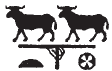 - Similar spellings occur in Esna 74, 34; Esna II, 16, 1; Esna III, 243, 10; Esna IV, 433, 1; 436; Esna VII, 586; 602, 11. Sternberg 1985, p. 62, n. a, transcribed this example as bȝ.wỉt. However, the simple ram elsewhere writes ṯȝ (< ṯȝy, “male”) in ṯȝw, “wind; breath”: Esna III, 378, 17 and 21; probably also in Leitz 2001, p. 260, Nos. 20-21.↩︎
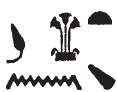 - Reading doubtful, the parallel in Esna VI, 474 is spelled similarly:
 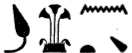 . Given the context, it might also be relevant to compare a term that shows up in connection with a goddess in Esna 75:
  . The lotus bud usually writes n at Esna, but at least once it spells r, in the nearby inscription Esna 56. This term, identical to the city of Illahun, literally means “mouth of the canal.” The reading might be supported by the subsequent use of the nearly homophonous verb rhn.↩︎
For the primeval ḏ-serpent who emerges from Nun with Irita, see Klotz 2012, pp. 171-174.↩︎
This key verb is used multiple times in the cosmogony of Neith-Methyer: Esna III, 206, 2, §5; 3, §7; 4, §8; as well as in Esna 80, 1.↩︎
The pun in Nebtu’s name seems to relate to the repeated w’s. However, note that the term nb.t is occasionally spelled wby in Demotic (Smith 1987, pp. 110-111), perhaps explaining the repeated wp’s here. The same series of etymologies for Menhyt and Nebtu occur in Esna VI, 546, 4.↩︎
 - Notable spelling.↩︎
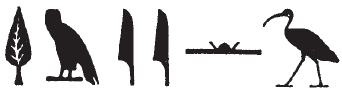 - Sternberg 1985, p. 64, n. h, split this into two separate clauses, and read the ibis as Dd, “to say.” However, the ibis actually does not write that verb (Kurth 2007, p. 251, 64; De Meulenaere 1954, p. 82), usually only the baboon form of Thoth.↩︎
Part of this text is restored thanks to Esna VI, 474, as well as a similar passage in Esna III, 395, 12:
 . The latter example indicates these Khnum gods with solar disks on their heads are to be read as “Great Khnums”, as confirmed by a similar spelling in Esna II, 16, 1.↩︎
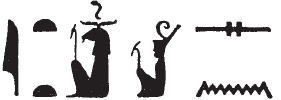 - Khnum and Neith.↩︎
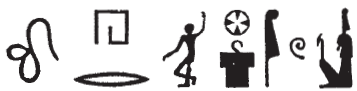 - Note the spelling of the dative (n=s).↩︎
 - Sternberg 1985, p. 66, n. aa, translated this as bȝ-dmḏ, “the united Ba”, a reference to the unified Re-Osiris. While this is certainly possible, Osiris is nowhere else referred to by this epithet at Esna; elsewhere it appears to refer to Khonsu-Thoth (Esna II, 31, 43). Instead, given the tendency for sportive writings of this name at Esna, I suggest this is partially acrophonic: w < wp + sr (< “ram”) (cf. Sauneron 1982, p. 137). The same group occurs in an isolated context in the cryptographic ram text Esna 103, 1; Leitz 2001, p. 255 (6) assumed it was bȝ-dmḏ, but again that is not a frequent epithet of Khnum. In that instance, perhaps the same principle is applied, and it simply writes wsr, “mighty.”↩︎
 - Sternberg 1985, p. 66, n. ad, interpreted ỉ(w) bsỉ s(w), “in order to inroduce him (Horus)”, continuing the previous section. But this is more difficult to connect to the following phrase, since Thoth is the one who does what the other divinities say. Elsewhere at Esna, a similar figure writes s in the titulary of Trajan (Esna IV, 469, S), apparently derived from sṯỉ, “to ejaculate; urinate” (cf. Kurth 2007, pp. 130, 13a; 139, 58, 58a; 159, n. 429); it is unclear which text is referred to with the Bes figure writing s in Sauneron 1982, p. 194. Similarly here, this figure could write s or sṯ, for the coordinating particle ỉs(ṯ).↩︎
 - Archaizing spelling.↩︎
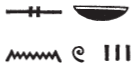 - Sternberg 1985, pp. 60-61, read the baboon as zȝ, “protection”, but this seems more likely to refer to Thoth carrying out their decrees.↩︎
This passage is restored after similar texts in Kom Ombo and Medinet Habu, which describe all the generations of divinities from creation to the living Horus (i.e. the king): Klotz 2009, p. 34, n. n.↩︎
Similar comparisons to Memphis in Upper Egypt in Esna IV, 431, 3; Esna VII, 549.↩︎
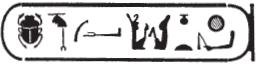 - This spelling is notable. The arm with water (traditionally: ỉʿ, “to wash”) represents the medial vowels in “Domitian.” The two kings do not write nsw-bỉty, but: n < (“red crown”) + s < sṯn (acrophony).↩︎
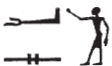 - Unusual spelling of this verb. For the phonetic change, cf. Kurth 2007, p. 532.↩︎
This phrase, originally “stable of goats (ʿnḫ.w)”, usually designates a mammisi; cf. Klotz 2012, p. 266, n. 270. In Esna II, 31, 61, this term designates the Temple of the Chicks, aka Per-Sahure, also identified with the primeval mound of creation. At Edfou III, 159, 5, however, it clearly designates the royal palace, which makes the most sense here.↩︎
 - Reading suggested from the context. Acrophony: ỉs = ỉ < ỉp.t, “hippopotamus” (Meeks 2006, p. 100, n. 282) + s < sḫmty, “double crown” (Sauneron 1982, p. 174).↩︎
For this verb at Esna, cf. Sauneron 1963b, pp. 49-51 (translating this example on p. 50).↩︎
 - Sternberg 1985, p. 70, n. f, suggested multiple readings of this sign, but the most likely is the first choice, ḫnt, “to go upstream (south).” This text focuses primarily on Neith’s journey south to Esna, ultimately resulting in an etymology for Khent-ta. The crocodile very frequently writes ḫnt at Esna.↩︎
In opposition to Lower Egyptian Thebes (wȝs.t-mḥt) near Neith’s primary temple in Sais: Guermeur 2011.↩︎
Rather than “the southern city (nỉw.t rsy.t)”, the syntax demands reading “south of the City”, a reference to Thebes (the location of this speech) which was often called simple “the City.” At the same time, there is an implied pun with the Rs-n.t chapel of Neith: cf. Esna 63, 1; Esna 84, 1, and eventually “Esna”, similar to “*Resno” (south of the city).↩︎
This is apparently an allusion to Nekhbet as a vulture perched at the southern limit of the sky.↩︎
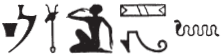
 - Partially following the ingenious reading of Sternberg 1985, pp. 71-72, nn. q-r. However, she understood the two ovals after the wedjat-eye as dual markers, but the following narrative only refers to a single eye. Instead, I understand this as a reference to the new moon, diminished (ʿnḏ) and in need of both protection and refilling by Thoth. The spelling of nṯr.ty evokes a very different reading: “and thus the turtle swallowed the wedjat-eye (ʿm štw wḏȝ.t)”, a dangerous cosmic event alluded to with similar hieroglyphs in Esna II, 6, 17 and 14 (also involving Thoth and Menhyt). Here the spelling of Tefnut apparently derives t < dwn-ʿ.wy, “Dewenawy” + f + n < nr.t, “vulture.”↩︎
This is the festival of Renenutet, mother of grain, in the final month of summer, leading up to the birth of the divine child days later on [Pachons 1], the beginning of the harvest season.↩︎
This is the birth festival for Heka starting on [Pachons 1].↩︎
 - sternberg, pp. 68-69, translated “sie begibt sich (sḫm=s)” without comment. In similar contexts, the most frequently used verbs are ʿq, “to enter” (e.g. Esna III, 197, 21; 340, 5; 346, 21), or šm, “to go” (Esna III, 340, 5; 346, 20 bis). The latter makes the most sense here, probably derived from šmʿ, “white crown.”↩︎
This is a common priestly title, most closely associated with Herishef in Herakleopolis Magna: Klotz 2014c, p. 778 (with references). ↩︎
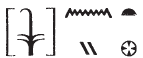 - The first sign is damaged, but it is most likely to be restored with an r, as in the beginning of this text:
 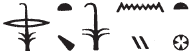 . Their is a phonetic pun here, linking the name “Esna” to the “Resnet” (Rs-n.t = “Southern Neith”) chapel in Sais. For similar abbreviated spellings of Esna, usually in similar contexts involving “southern Rs-n.t”, see Klotz 2014b, p. 42, n. a.↩︎
Restoration uncertain, but the subsequent lines describe taking care of primeval ancestor gods. Moreover, the suffix pronoun for that location is always masculine, suggesting this might be Pr-nṯr, rather than any toponym beinning with ḥw.t. For Neith’s voyage to Per-netjer to give food to the deceased gods, see Esna 163, 26-28.
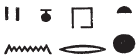
↩︎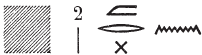
 - Although the beginning of this date is damaged, it appears to be: 1/2 + 1/30 = 15 + 1 = 16. However, there is no entry for 16 Meshir in the festival calendar from Esna. Rather, there is one ceremony for Neith on 8 Meshir (Sauneron 1962, pp. 18-19, with n. d), and another specifically for Neith of Lower Egypt on 17 Meshir (ibid). The latter option seems most likely, since it appears to mention a “Festival of the Bow (ḥb šmr.t) for (n < m < Mnw) the Lady of Sais” (Esna 55, 9; different translation by Sauneron 1962, p. 19, n. e), and Neith specifically carries her bow in this text as well.↩︎
Note that this is precisely the phrase Neith herself says before creating Sais at the beginning of time Esna III, 2-6, 2; cf. Sauneron 1962, p. 255, n. a. The same phrase is used for her temple in Esna VII, 587, 16; 634, 9.↩︎
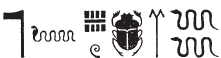 - A frequent epithet at Esna, which appears to refer to a primeval Kematef serpent (Neith) creating a similar, ophidian demiurge (Khnum-Tatenen); cf. Klotz 2012, pp. 173-173. The mother and father serpents are said to be indistinguishable in Esna 65, 2.↩︎
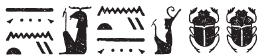 - Thanks to acrophony, Tatenen (TN) and Neith (NT) can be written as palindromes, as in the parallel Esna 104, 4. Elsewhere this happens with a vulture (n) and scarab (t) (e.g. Esna 71,6; cf. A. von Lieven 2010), so it is less clear what the two scarabs are doing here. They either refer to each divinity, or this is the beginning of a standard epithet such as occurs in [Esna 104, 4]: ḫpr ḫpr.w, ḫpr ḫprw nb m-ḫt [ḫpr=sn].↩︎
For these gods in general, cf. *goyon-gardiens.↩︎
For this epithet of Ptah, creator of the primeval egg, see Mendel 2003, pp. 44-51.↩︎
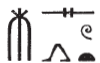 - Wb II, 142, 7, records a rare term spelled this way, meaning “to show respect.” Those examples seem to be related to the verb hỉms, “to approach respectfully” (Wb II, 484,4-8), hence the present translation.↩︎
Epithet of Khnum immediately above this text: Esna 61, 6-7.↩︎
For this and similar epithets at Esna, cf. Klotz 2014b, pp. 38-39, n. c. ↩︎
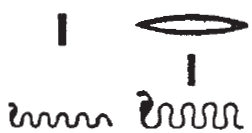 - Note the spelling: a single stroke for “one”, with a serpent determinative; the reading is confirmed by Esna II, 17, 63. Khnum and Neith are two primeval serpents (above, col. 1), Irita and the Living Goddess, impossible to tell apart.↩︎
For Khnum and “the goddess with him” (Neith-Menhyt), cf. Esna II, 17, 63; Esna 64, 2.↩︎
Literally: “the place of ‘forehead to the ground’”↩︎
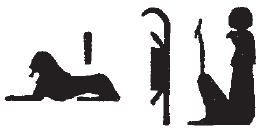 - The wrong harpoon is used to write wʿ, “sole.”↩︎
This was one of the most important festivals at Esna; cf. [Esna 48 A].↩︎
 - Good representation of the forecourt, including the intercolumnar panels. The same hieroglyph is used in Esna 156, 20.↩︎
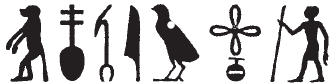 - Sauneron 1964a, p. 19, discussed first part of phrase. The wȝs-scepter stands for two grammatical elements: the -wy ending + the pronoun sw. However, he did not mention the standing man. Based on context, I suggest reading this sign as the adverb ḫnt, “before” < ẖntỉ, “statue.”↩︎
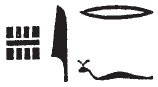 - Similar spellings of ptr without the medial consonant (cf. Coptic: ⲡⲱⲱⲣⲉ) are known from the Graeco-Roman period: Sauneron 1961, p. 240; Klotz 2010, p. 71, n. 25.↩︎
Same ending to the monography in Esna 85, 4, but there referring to Neith.↩︎