Intercolumnar Wall F and South-East Door (104-110)
Esna 104
- Location: Intercolumnar Wall F, over the lintel
- Date: Probably Domitian
-
Hieroglyphic Text
- Bibliography: Sternberg 1985, pp. 92-99; see also Tempeltexte 2.0
- Parallels: Esna 65, 3 (partial); Esna 73, 8-9 (partial)
- Photograph
1ỉr ỉȝ.t-ṯȝ.wy
ḏ(d.tw) r Iwny.t
ḥw.t-ỉt pw
ḥw.t-mw.t mỉt.t
ḫpr m ḥȝ.t
štȝ(.w) m-ḫnt=f
nṯr ȝms-ỉb
ỉỉ n ʿš n=f
sḏm spr n tpy.w-tȝ
tȝ-ṯnn kȝ.tw m rn=f
2qdỉ.n=f rmṯ
ỉr.n=f nṯr.w
ẖnm.n=f ḥr.w-nb
ḥr nḥp=f
sḫpr.n=f wnn.t nb
m rȝ-ʿ.wy=f
As for the District of the Chicks,
so (one) calls Iunyt.
It is the Temple of the Father,
and the Temple of the mother likewise,
He who came about in the begining,
is kept secret within it,
the kind-hearted god,
who comes to whomever calls him,
who hears prayers of those on earth.
He is called Tatenen by name:
as he built humans,
so he made the gods,
he joined everybody
upon his potter’s wheel.
He created all the exists
through his handiwork.
štȝ.t ỉm
m nṯr.t ḥnʿ=f
ḫpr=sn ḫpr nty(.w) nb
qmȝ gb.t
3wȝḥ ḫt-mn
ỉr ỉḫt nb
m qmȝ.n ỉb=sn
ḏd.ỉn ỉt n mw.t
ẖnm=ỉ ḥnʿ=ṯ
ḥʿw=ỉ tm(.w) n ʿnḫ
ḏd.ỉn mw.t
ỉw=ỉ mn.tw ḥnʿ=k
mḥn=ỉ ḥr-tp=k
mnḥ[=ỉ] 4 tp.w
nw ḫfty.w=k
ḫpr ẖnmw m rn n tȝ-ṯnn
mnḥy.t m rn n N.t
nṯr wʿ ḫpr m sn.w
tȝ-ṯnn N.t
ḫpr ḫpr.w
ḫpr ḫpr.w nb
m-ḫt [ḫpr=sn]
The Mysterious one269 is therein,
as the goddess together with him.
As they came about, all that is came about.
They who created the sky,
13 who laid down the earth,
who made all things
through the creation of their heart.
Then the Father said to the Mother:270
I will join (ẖnm) with you,
so my body is complete of life.
Then the Mother said:
I will remain (mn) with you,
I will coil (mḥn) upon your head,
and chop off (mnḥ) 4 the head(s)
of your enemies.271
Thus Khnum became the name of Tatenen,
Menhyt the name of Neith:
the single god who became two,272
Tatenen (TN) and Neith (NT),273
who made transformations,
all that exists came about
after they came about.
5[ỉt] m ẖnmw
mw.t m Mnḥy.t
Nb.t-ww kȝ.tw r kȝ=s
ntsn ʿȝ.w wr.w mnḫ.w
wnn ḫy šp(s)
pr (ḥr) nḫb
m qȝy qȝ […]
6[zȝ?] N.t pw
ỉwʿʿ n tȝ-ṯnn
nhq.n ỉb=f
r ỉqḥ ḥw.t-ỉt
r mȝȝ sḫr.w n Nwn-wr
5 [The father] is Khnum,
the mother is Menhyt,
her Ka is also called Nebtu:
they are the very great, beneficent ones.274
The august275 child
who came forth (upon) the lotus
in the High Mound […]
6 That means [the son] of Neith,
the heir of Tatenen:
his heart was inspired 276
to enter the Temple of the Father,
to see the condition of Great Nun.
snḏm=f ỉm
ẖnm=f m-ḫnt=f
ỉw=f m rw
ṯȝ.wy=f m rw.ty […]
7[…]
ỉt=w Nwn ȝṯt.n=sn
ʿnḫ=sn m ỉrṯ.t
n.t mw.t=f
ỉw=sn m sbq.wy
ḥr ỉmḥ (i)m=s
swr=s pḥty=sn
m ỉrṯ.t=s
sḫr.n=f sbỉ=sn
8[wdỉ]=s šsr=s
r sṯ(.t)=s r ḫfty.w
ḫpr=sn m nb(.wy) pḥty
nḫt-ḫpš.w
smȝ=sn sbỉ.w nw ỉt=sn
m-ẖnw ỉȝ.t tn
nty ḥr mḥ.t n nỉw.t ṯn
He installs himself there,
and unites with him within it.
He is as a lion277
his two children are the two lions […]
7 […]278
It is their father Nun who nursed them,
and they live from the milk
of his mother (Neith),
they being as two crocodiles279
nursing280 from her,
she increases their strength
through her milk.
She struck down their rebels,
8 [shooting] her arrow
so she might strike against the enemies.
The turned in to Lords of Strength,281
mighty of limbs,
they slaughter the rebels against their father,
within this mound,
which is to the north of this city.282
pr-ẖnmw n [sḫ.t]
9[ʿb].tw r ʿb
ḫw.tw r ḫrwy.t
nỉ ʿq ỉḫt nb ḏw m-ẖnw=s
ḏd.ỉn šw
zȝ(ṯ)=i pw zȝ.tw
n mw.t-nṯr
m nỉw.t rsy.t
ḫpr tȝ-sn.t pw
wnn 10[ʿnḫ]=ỉ ḥnʿ sn.t=ỉ
m ỉrṯ.t=s
ỉw=n m ṯȝ.wy m nỉw.t ṯn
ḏd.tw ỉȝ.t-ṯȝ.wy
m rn n spȝ.t tn
zȝ=sn mr=sn
[…] 11[…]
ỉḥy nfr zȝ nỉw.t=f
Gbb pw kȝ.tw r kȝ=f
nt.w-ʿ=f mn(.w) m-ẖnw Iwny.t
wḥm.n=f msḫʿ.w m tr r tr
n tr=f […]
Per-Khnum of [the Field],
is [purified]283 from all impurity,
protected from all calamity,
nothing evil can enter inside it.
Then Shu said:
‘This my land is protected (zȝw)
for the Mother of God
in the southern City (nỉw.t)!’
So came about ‘Esna.’284
‘I am [living] with my sister
from her (Neith’s) milk.
We are as chicks in this city.’
Thus ‘Mound of the Chicks’ is said
as the name of this nome.
Their beloved son,
[…Heka?…] 11
good Ihy, who protects his city,
that means Geb, as he his Ka is called.
His activities endure within Iunyt,
having repeated births from time to time,
at his season […]
Esna 105
- Location: South-east door, lintel
- Date: Unknown, probably Domitian
-
Hieroglyphic Text
- Bibliography: None
- Photograph
1ṯȝw nfr n rsy.t
šhb rn=f
2ntf ṯz bȝ.w n nṯr.w
3r p.t
sʿq=f šwy
4m ỉȝbt.t
bs.n=f ḥʿpỉ m ṯpḥ.t
r bʿḥ Iwny.t m kȝ.w ḏfȝ.w
5ỉỉ.tw hr.tw
ỉr nfr n Iwnyt
6n=k ỉmy pr nb
n ḥʿpỉ 7rsy
ḥȝy m ḥȝy
ḫȝḫ[…]
[…] 8ḥw.t-ẖnmw
n ỉt m šȝʿ
ʿbḫ.n=f fnḏ=f
1 The good wind of the south:
Sheheb is his name.285
2 It is he who lifts the bas of the gods
3 up to the sky.
As he made the crocodile enter
into 4 the right-eye,286
so he made Hapi come forth from the grotto
to flood Iunyt with food and provisions.
5 Come! Be peaceful!
Act kindly for Iunyt!
6 To you belongs all that comes
from the 7 southern Hapi.
Blow in as the wind!
Hurry […!]
[…] 8 the temple of Khnum
of the Father in the Beginning,
having uniting with his nose.
Esna 106
- Location: South-east door, left side
- Date: Domitian
- Hieroglyphic Text
- Bibliography: None. But see A. von Lieven 2000, p. 135, for a translation of the close parallel.
- Parallels: Esna IV, 436.
1wnn Iwny.t m sḫr.w
n hȝy.ty
ỉrỉ-wḥm m ḥr-ỉb=s
psḏ n=s psḏ-m-nbw
ḫy šps
wbn m ỉh.t
tp-ʿ bẖ
m ỉtn nfr n tȝ-ṯnn
mȝwy=f ṯnỉ[…]
[…] sw
m Itm ḫntỉ Mȝnw
1 While Iunyt is formed in the design
of the double firmaments,
the solar course287 is within it
and He-who-shines-as-gold shines288 for it.
The august289 child,
who ros[e] from the Ihet cow,
at the beginning of dawn,
as the beautiful disk of Tatenen,
whose rays distinguish[…]
[…] him,
as Atum, foremost of Manu.
2wnm.t=f ỉȝbt.t=f
ẖnm(.w) ỉm=s
nṯr.ty (ḥr) wbn
r-ḥr n nb=sn
(ḥr) srs ḥr.w-nb nmʿ
bȝ ḏsr ḫprw
m fdw ṯȝw
pr=sn
m rn n ḥm=f
nšp[.tw m ẖn]m.ty=f
r šnw n ỉtn
2 His right and left eye
are united therein,
the divine eyes rise
before their lord,
awakening all who are sleeping.
The Ba sacred of form,
as the four winds,
they come forth
at the name of his majesty,
and [one] breathes from his [no]strils,
to the circuit of the sundisk.
3sn.t=f nfr.t
(ḥr) ỉr.t wḏ m p.t
ỉmy rnp.t=s
ḥnw.t n ḫȝbs.w
ḫpr ḫpr.w
ḫft kȝ=sn
ȝḫ.t=sn m-ẖnw Iwny.t
ỉwn ỉm=f
ẖnbb[.n=f] r ȝḫ.t
s.t-ỉb=sn
ȝḫ
ḫʿy.t pw […]
3 His good sister
makes commands in heaven
during her year,
the Mistress of the Decan stars:
all things come to pass
according to what they say.290
Their Akhet is within Iunyt.
The Pillar (ỉwn) is in it291,
[as he] travels toward the Akhet.
Their favorite place,
more excellent than heaven.
It is the initial mound […]
4[…] m nb
[…] ḥtp
pr m […] ỉȝ.t
n ỉr wnn.t
bȝ n Rʿ m zp-tpy
wṯz-ḫʿ ỉm
ḥnʿ psḏ.t
ẖnm bȝ=f ḥnʿ ʿḫm=f
ḥȝy=f ḥr(.w)
n ỉmy.w tȝ-sn.t
dỉ=sn ỉr zȝ-Rʿ
(twmtynz ḫwỉ)| […]
4 […] as the lord
[…] peace,
going forth […] mound,
of he who made what exists.
The Ba of Re in the first moment,
who holds processions there
together with the Ennead,
his Ba unites with his statue,
he brightens the faces
of those within Esna.
May the let the Son of Re,
(Domitian Augustus)| […]
Esna 107
- Location: South-east door, right side
- Date: Domitian
- Hieroglyphic Text
- Bibliography: el-Sayed 1982, p. 638, Doc. 1033 (very brief)
1wnn tȝ-sn.t m tȝ ẖr nṯr.w
ʿḥʿy[-nfr] m ḫnt=s
[..sḫr].w nw tȝ r-ȝw=f
ỉt m šȝʿ
ḥr qdỉ m nḥp=f
šȝʿ ʿnḫ n Km.t ḏs=f
Mnḥy.t mn.tw ḥnʿ=f
nỉ ḥr=[s r=f] rʿ-nb
štȝ.t m N.t
zȝ[=s…]
[…] 2m šww
wnm.t=s ỉȝb.t=s m ỉtn.wy
nb sḫ.t (ḥr) ẖnm snt=f
mḥy.t
(ḥr) srwḏ rwḏ.w
1 Esna is the land bearing the gods,
the [good] agathos-daimon is in it,
[…condi]tions292 of the entire world.
The Father in the beginning
is building with his potter’s wheel,
beginning life for Egypt by himself.
Menhyt dwells (mn) with him,
never leaving [him], daily.
The remote sky is Neith,
[her son …]
[…] 2 as the sun.
Her left and right eyes are the two disks.
The Lord of the Field joins with his sister,
the north-wind,
making plants thrive.
ḏȝỉs.w wr.w (ḥr) ṯz Nwn r nw=f
(Wn-nfr mȝʿ-ḫrw)|
ṯz.tw ḥr nmỉ.t=f
sn.ty […]
[…]r=f
[…]
The great Djaisu elevate Nun at his time.293
(Wennefer, justified)|
is elevated upon his bier.
The two sisters (Isis and Nephthys)294 […]
[…] him.
[…]
3ḥkȝ m sḏty ỉqr
Rʿ m nḫn
m wḥm msḫʿ.w
Gbb pw sṯȝm.n=f ȝḫ.t
(ḥr) sḫpr ḫ.t-n-ʿnḫ n ʿnḫ.w
ẖnmw pȝ nḫy nfr m gs-dp
ṯȝw n ʿnḫ n tpy.w-tȝ
ỉb n Rʿ […] ỉḫt
[…]
3 Heka is the excellent child,
Re as a youth,
repeating births,
he is Geb, having fertilized the field,
creating the ‘wood of life’ for the living.
Khnum the Good Champion is on guard,
the breath295 of life for those on earth.
The heart of Re (Thoth) […] things
[…]
[…] 4tȝỉty-zȝb(?)
(ḥr) sḥtp ḥm n rw.ty
ms.w Rʿ ḥʿʿ.w m pr=sn
sḫr.w n tȝ m ḥr=sn
twtw zȝ N.t
ḥr-tp n ḫȝty.w
šnw n tȝ ẖr wḏ=f
š(m)ʿ-nfr m […] Iỉ-m-ḥtp
ỉwʿʿ n rsy-ỉnb=f
(ḥr) snfr mḥr.w nb m ḏ.t=f
dỉ[=sn …]
[…] (twmtyns […])|
[…]
[…] the judge,296
pacifying the majesty of the Two Lions.297
The children of Re rejoice in their temple,
the affairs of earth are [be]fore them.298
Tutu, son of Neith,
chief of the avenging demons,
the circuit of the earth is under his command.
Shemanefer299 is […]300 of Imhotep,
the heir of Resy-inebef (Ptah),
healing all the sick with his body.
May [they all] give […]
[… to] (Domitian […])|
[…]
Esna 108
- Location: South-East Door, Interior, Ceiling
- Date: Domitian
- Hieroglyphic Text
- Bibliography: None
Esna 109
- Location: South-East Door, Interior, North face
- Date: Domitian
- Hieroglyphic Text
- Bibliography: None
Cartouches of Domitian.
Esna 110
- Location: South-East Door, interior left
- Date: Probably Domitian
-
Hieroglyphic Text
- Bibliography: None. References to LGG in Tempeltexte 2.0
NB: This text is extremely obscure. Obviously it is some sort of ritual text aimed at driving away impurity from the temple, and protecting the food of Khnum-Re, and possibly Nebtu (lines 14-15). As such, it is comparable to the ritual text preserved in the opposite door Esna 131. I know of no direct parallels.
1[wbn?] Rʿ
nwr ḥry.w-mw
hwt 2ỉr=f
psḏ.t wr.t m Iwnw
1 When Re [shines?]
those Upon the Water tremble.
It wails, 2 truly,
the Great Ennead in Heliopolis!
hȝỉ m p.t
prỉ m ȝḫ.t
ḫrs ḥry.w-mw 3ỉpw
Which comes down from heaven,
and emerges from the Akhet,
and repels These 3 Upon the Water.
sȝq=s ʿ.wy=s
ḥr ḥrr.w nb
ḥry.w-mw ỉpw
It gathers its arms
around all snakes,
o These Upon the Water.
wʿb
ỉỉ m p.t
šms […] Rʿ
O pure one,
who comes from heaven,
and follows […] Re.
4ỉn ḥr snṯr=sn
ỉn ḏḥwty dỉ ḥsmn=sn
ỉn sšȝ.t dỉ ḥnq.t=sn
5ỉn Wp-wȝ.wt wp.n=f ẖ.t=sn
4 It is Horus who censes them,
it is Thoth who gives their natron,
it is Seshat who gives their beer,
5 it is Wepwawet who opened their bodies.
ỉw=w […] ʿ.wy […]
6ḥḏ-tȝ
ỉtn zȝ=f tn
They are […] arms(?) […]
6 at dawn,
the sundisk protects you.
hwt […]
7 ʿ=s ḥȝ Gbb
wp=s rmn.wy
(ḥȝ) Wsỉr
ḏr ỉw […]
8ḫrs n=f šw.t-nṯr
sḥtm […]
9tfy nt mwt mwt.t
It wails […]
7 her arm around Geb,
she opens her shoulders
around Osiris,
since […] comes […],
8 the Shadow of God repels for him,
and destroys […]
9 this […] of any ghost.
ḥry.w-mw ỉpw
ỉw sḫm.t sḥr=s ỉḫt nb ḏw
[…] 10nfw=s
ḥry.w-mw ỉpw
ỉsds sḥr=f ỉḫt nb ḏw
ḏȝ.t (ḥr) šm n ȝ.t=sn
ḥry.w-mw ỉpw
ỉḫt nb ḏw
(ḥr) šm n šw.t-nṯr
mwt mwt.t ḥm.t-rȝ
ḥry.w mw ỉpw
12ḏḥwty sḥr=f ỉḫt nb ḏw
ḥry.w[-mw ỉpw]
ỉr.n […]
13[ḥry.w]-mw ỉ[pw]
n ẖnmw-Rʿ [nb-tȝ]-sn.t
nṯr ʿȝ pfy […]
O These Upon the Water:
Sakhmet drives away all evil things,
[…] 10 her breath.
O These Upon the Water:
Isdes drives away all evil things,
enemies go off to their moment.
O These Upon the Water:
all evil things
go off to the Shadow of God,
all ghosts, etc.
O These Upon the Water:
12 Thoth drives away all evil things.
O [These] Upon [the Water]:
[…] did […]
13 O T[hese Upon] the Water,
for Khnum-Re [Lord of E]sna,
this great god […]
[wnm=f] 14nn t
swr=f nn ḥnq.t
ỉr=f zȝ=f
ḥsmn=f m […]
15ȝw.t-ỉb=s […]
ỉn Nb.t[-ww?]
ḥry.w-[mw ỉpw]
[…]
[He eats] 14 this bread,
he drinks this beer,
he carries out his protection
his natron is […]
15 she is happy […]
by Nebt[u?]
O [These] Upon [the Water]
[…]
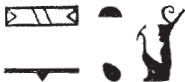 - This is a frequent epithet of Neith at Esna, but this spelling could also be read simply as “Neith”, as Sternberg 1985, pp. 92, 95, n. i, understood this example. I prefer the epithet here because of the narrative: the chief divinities are referred to only as “father” and “mother” so far, only receiving their official names later via etymologies.↩︎
From the determinatives, Khnum and Neith, even though neither divinity has been named yet.↩︎
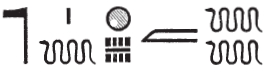 - Close parallel in Esna 63, 3. For the reading of this epithet, see Klotz 2012, pp. 173-174. It seems to refer to Neith-Kematef as the first serpent, who then generates Khnum-Irita and Menhyt-Neith (the ḏ-serpent) as the second generation. The result is a pair (Neith-Menhyt and Khnum), unlike the Heliopolitan triad mentioned below (lines 6-7, partially damaged), where Re creates Shu and Tefnut, but remains distinct from them who creates Shu and Tefnut and unites with them as a triad, as “the sole god who became three.”↩︎
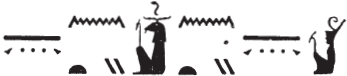 - For the palindromic spellings of Tatenen and Neith, cf. also Esna 63, 5; Esna 71, 5.↩︎
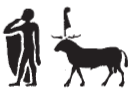 - This spelling is missing the final s, as found in Esna 59, 1; Esna 106, 1 (noted by Sternberg 1985, p. 96, n. q)↩︎
For the verb nhq, see primarily Sauneron 1964a, pp. 18-19.↩︎
The hieroglyph is technically a cat, which makes perfect sense for Re (so Sternberg 1985, p. 97, n. t). However, the context and parallel in Esna 73, 8, suggests this should actually be translated “lion.” The same use of the cat to write “lion” in standard epithets also occurs in Esna 187 A, Esna 187 B; and possibly Esna 127, 5.↩︎
Based on the parallel in Esna 73, 9, probably restore: “thus he created the trio (qmȝ.n=f ḫmt)”; cf. also Esna 80, 4. This is different from the pair of primeval gods (Khnum-Tatenen and Menhyt-Neith) evokes above, line 4.↩︎
Another allusion to Neith as the crocodile mother (Rs.t-ḥw.wt=s) nursing two crocodiles at the same time: cf. Thiers 2015 312-314, n. ac. Here the chidlren appear to be new manifestations of Shu and Tefnut, previously identified as lions (line 6).↩︎
 - For reasons of dissimilation, the false dual pḥty, “strength” is written with a lion and lionness (Shu and Tefnut).↩︎
Reference to the slaughter of enemies in Per-netjer (North Esna) on Payni 9, discussed in greater detail in Esna III, 196; cf. also Esna 127, Esna 129.↩︎
Sternberg 1985, p. 99, n. ag, restored ḏsr, but that misses the alliteration here.↩︎
 - That is, “the land of protecting (zȝw) the city (nỉw.t).” Such spellings of Esna are not uncommon. A curious detail is that Shu employed the rarer term zȝṯ, “ground; land”, rather than tȝ, which would have made the etymology clearer. The same occurs in the Neith-Methyer cosmogony, where there are multiple puns between zȝṯ, “ground” and Zȝw, “Sais”: Esna III, 206, 2, §5; 12, §17.↩︎
For this manifestation of the south-wind, see LGG VII, 111a-b and 458a; Riggs 2006, pp. 317-320 (both with references). The first lines of this text find exact parallels in the Ptolemaic chapel of Hathor, Deir el-Médinâ 112, 3. Based on those other versions, this figure can be restored as a lion with a ram head and four wings; this same figure appears without caption in the astronomical ceiling: Esna IV, 451, 7 (East) (noted by Daniel Arpagaus, personal communication). The eastern wind appears in a symmetric scene Esna 128.
↩︎Darniel Arpagaus (personal communication) suggested this obscure reference might be illustrated on the astronomical ceiling of Esna (Esna IV, 451). In the eastern side, the south-wind faces a crocodile with the head of a cobra for a tail. The precise astrological significance of this phrase and scene remains obscure to me.↩︎
 -↩︎
-↩︎ -↩︎
-↩︎An astrological concept. The decan stars determine all things that happen on earth.↩︎
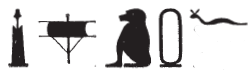 - In Klotz 2014b, pp. 49-50, I had discussed possible readings for this passage. Since there are problems with both interpretations suggested there, I am now inclined to see yet another example of ‘banal acrophony’ here, with the cartouche writing m < mnš, “cartouche”; cf. Sauneron 1982, pp. 182, 193.↩︎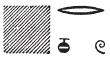
 - Similar spellings of this word with the nw-pot occur in Esna 129, 3; Esna III, 204 A; 277, 25 (10); Esna IV, 422, 2.↩︎
The ancestor deities from Esna, created by Neith. Their name, ḏȝỉs.w, is an alternate spelling of ṯz.w, “utterances,” hence the wordplay with the verb ṯz, “to lift up” here. Like the Ogdoad in Thebes, these gods apparently regulated the annual inundation of the Nile, as mentioned in Esna 58, 2; Esna VI, 474.↩︎
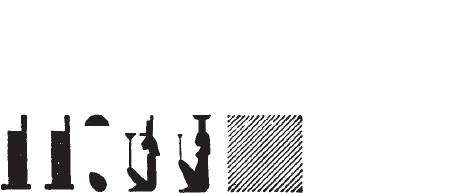 - Unusual spelling that looks more like “the two Isises.”↩︎
 - This is a keyword in the theology of Khnum, and it often shows up in unorthodox, phonetic spellings. For this particular spelling with the phallus, see also Esna 180 B; Esna III, 277, 23 (8), 25 (11); 355, 3 (28), 6 (33); 371, 19; Esna IV, 422, 3.↩︎
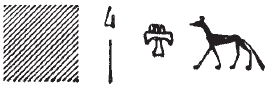 - Reading uncertain because of the preceding damage, but this apparently refers to either Thoth or Khonsu at Esna. The same epithet in Esna II, 31, 43.↩︎
That is, Shu and Tefnut.↩︎
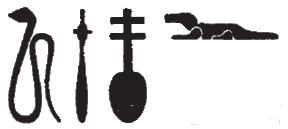 - Note the unique spelling, which etymologically links Shemanefer to the “Great Shai” serpent.↩︎
Because of the lacuna, it is unclear how precisely Shemanefer is related to Imhotep. He might be his “son”, or also his “likeness”, “living image.”↩︎